

If you already deliver services under the National Disability Insurance Scheme (NDIS), adding Department of Veterans’ Affairs (DVA) clients can feel like a natural next step. The client groups overlap more than most providers expect. An occupational therapist supporting an NDIS participant with a physical disability has almost exactly the right skill set to support a veteran recovering from a service-related injury. A physiotherapy or psychology practice that has already built policies, documentation habits, and a support-worker onboarding process for the NDIS is well ahead when it comes to meeting DVA’s expectations.
The commercial logic is straightforward too. Diversifying your funding across two government schemes reduces the risk of relying on a single income stream, smooths out referral gaps, and lets you keep skilled staff fully booked. But here is the trap: DVA and the NDIS look similar on the surface and behave very differently underneath. They have different registration pathways, different billing systems, different rulebooks, and completely separate audit and compliance regimes. Treating them as “the same thing with a different logo” is the single most common reason dual practices run into trouble.
This guide walks through how the two schemes actually differ, the practical steps to run both compliantly, and where providers most often slip up.
DVA vs NDIS: the differences that actually matter
Before you take on a single dual client, it helps to understand where the two schemes genuinely diverge. These are the distinctions that create compliance risk when they are misunderstood.
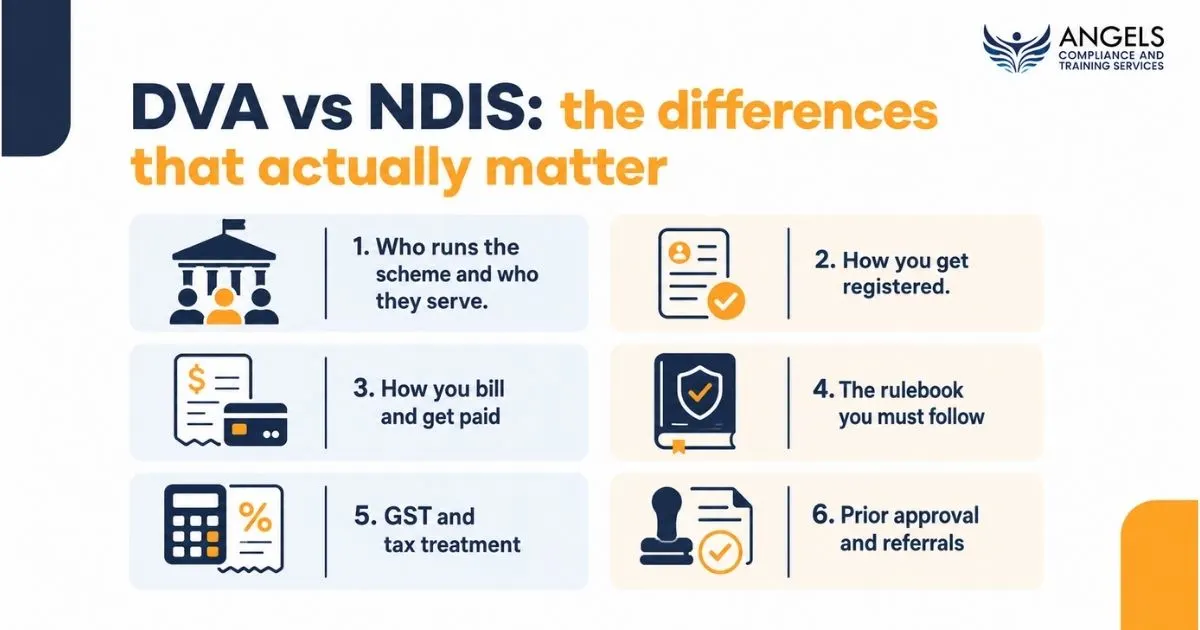
1. Who runs the scheme and who they serve.
The NDIS supports people with permanent and significant disability and is overseen by the NDIS Quality and Safeguards Commission. DVA funds health services for eligible members of the veteran community, including Gold Card and White Card holders under Commonwealth legislation. The Department of Veterans’ Affairs explains that it pays for services necessary to meet a clinical need, which is a different eligibility test from the NDIS “reasonable and necessary supports” model tied to a participant’s plan.
2. How you get registered.
NDIS registration is an active, formal process: you apply, undergo an audit against the NDIS Practice Standards, and receive a certificate. DVA is largely the opposite. For most allied health professionals, registration with DVA is automatic once you hold a Medicare provider number; there is often no form, no portal login, and no approval email. A smaller group of disciplines must still apply manually. Providers who assume DVA works like the NDIS waste weeks waiting for a confirmation that never arrives.
3. How you bill and get paid
NDIS providers invoice against a participant’s plan and the NDIS price limits. DVA claims are processed by Services Australia on DVA’s behalf, and you must accept the DVA fee schedule as full payment; you cannot charge veterans a gap or co-payment. As the DVA notes, if a provider accepts a Veteran Card, they can’t ask the client to pay a gap fee.
4. The rulebook you must follow
NDIS providers work to the NDIS Practice Standards and Code of Conduct. DVA providers must comply with the “Notes for providers” that apply to their profession, which the department states are legally binding. Two different documents, two different sets of obligations.
5. GST and tax treatment
DVA pays through a recipient-created tax invoice (RCTI) arrangement. If you are registered for GST, you must lodge the D9537 form recording your ABN and GST status, and DVA is explicit that claims cannot be paid inclusive of GST unless that form is processed before the claim is assessed. The NDIS has its own GST treatment for supports. Getting these crossed over causes payment delays.
6. Prior approval and referrals
DVA requires prior financial approval for certain non-listed treatments and works on a GP-referral treatment-cycle model for allied health. The NDIS works from an approved plan and (for registered providers) service agreements. The paperwork that authorises you to start treating looks nothing alike between the two.
Understanding these six distinctions is the foundation. Everything that follows is about building systems that respect both rulebooks at once without letting one bleed into the other.
How to set up and run a dual practice compliantly
Once you know where the schemes differ, running both cleanly comes down to disciplined separation and good documentation. Here is a practical, step-by-step approach.
- Confirm your DVA registration pathway first. Do not assume. If you are an AHPRA-registered allied health professional with a Medicare provider number, you are likely auto-registered with DVA, but disciplines such as general social workers, neuropsychologists, orthotists and lymphoedema providers must apply directly. Check your profession against DVA’s provider pages before you accept a veteran client. Our own breakdown of the auto-registration versus manual application question walks through exactly which group you fall into.
- Get your PRODA and claiming set-up right. Being “registered” with DVA does not mean you can claim. You need a Provider Digital Access (PRODA) account to lodge through Services Australia, and if you charge GST, you must have your D9537 RCTI agreement processed before your first claim. Sort this out before you deliver services, not after an unpaid invoice forces the issue.
- Keep two separate client-file structures. A DVA veteran and an NDIS participant should never share a documentation template. Their consent forms, referral triggers, goal-setting language, and reporting obligations differ. Build (or have built) two clean sets of policies and forms so staff always know which scheme’s rules apply to the client in front of them.
- Map your billing so the two schemes can’t collide. Set up distinct item codes, invoice templates, and claim workflows for DVA versus NDIS. The fastest way to trigger a compliance problem is to bill a DVA service against an NDIS plan, or to apply an NDIS price where a DVA fee schedule applies. If you need help structuring policies and procedures across both, our NDIS policies and procedures support can be adapted to cover DVA workflows too.
- Train staff on “which hat am I wearing?” Every clinician and support worker should be able to tell you, for any given client, which scheme funds them and which rulebook governs the session. This is a training issue, not an admin issue. Structured onboarding, the kind covered in our support worker induction and orientation program, prevents the honest mistakes that surface in audits.
- Run separate compliance calendars. NDIS registration renewal, mid-term audits, and worker screening checks sit on the NDIS side. DVA compliance obligations, fee-schedule updates (DVA indexes fees on 1 July each year), and Notes reviews sit on the other. Keep both on a single practice calendar so nothing lapses.
- Document everything, twice as carefully. When you operate across two funders, your records are your protection. Clear notes showing the referral source, the funding scheme, the clinical justification, and the applicable fee schedule mean that if either the NDIS Commission or DVA reviews your files, the story is obvious and defensible.
Done well, a dual practice is not twice the work; it is one strong compliance culture applied consistently to two rulebooks.
The most common mistakes dual providers make
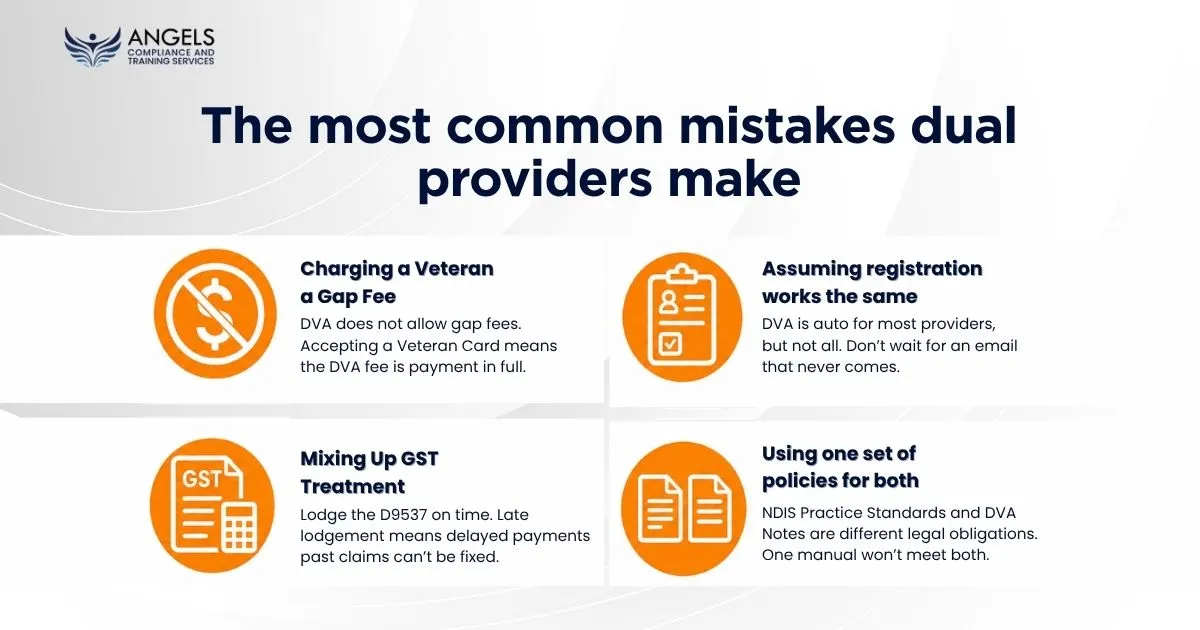
Even experienced providers slip up when they add a second scheme. The mistakes below come up again and again, and every one of them is avoidable.
Charging a veteran a gap fee is perhaps the most damaging. Because NDIS providers sometimes charge participants for services outside a plan, providers new to DVA occasionally assume the same flexibility exists. It does not. Accepting a Veteran Card means accepting the DVA fee as payment in full.
Assuming DVA registration works like NDIS registration is the second big one. Providers wait for an approval email that never comes, delay treating veterans, and lose referrals when, in many cases, they were auto-registered from day one. The reverse error is just as costly: assuming you are auto-registered when your discipline actually requires a manual application.
Mixing up GST treatment between the two schemes routinely holds up DVA payments. Lodging the D9537 late does not retrospectively fix claims already assessed, so the money simply does not flow until the paperwork catches up.
Finally, running a single set of policies for both schemes is a quiet audit risk. NDIS Practice Standards and DVA Notes are different legal instruments. A generic “compliance manual” that gestures at both usually satisfies neither. If your NDIS audit is approaching, treat DVA as a separate stream and if a previous audit hasn’t gone smoothly, our NDIS audit and compliance support is built exactly for this situation.
Where to get help
Running a compliant dual DVA and NDIS practice is entirely achievable; providers do it successfully every day. The difference between a smooth operation and a stressful one usually comes down to setting the foundations correctly: the right registration pathway, clean billing separation, well-trained staff, and two distinct but well-maintained compliance systems.
At Angels Compliance and Training Services, we help allied health and disability providers across Australia navigate both schemes with confidence. Whether you need DVA registration support, NDIS registration or renewal, policy and procedure development, or audit preparation, our team can map a compliant pathway for your specific service type.
