
Every registered NDIS provider knows the Worker Orientation Module is non-negotiable. It’s the one training requirement written into the rules, the one every new starter completes before they set foot in a participant’s home. But here’s the uncomfortable truth that surfaces in almost every certification audit: the Orientation Module is the floor, not the ceiling. Providers who treat it as the whole of their training obligation are the ones who end up staring at a non-conformance report, scrambling to explain why they can’t prove their workforce is competent.
The gap isn’t usually that providers fail to train their people. It’s that they can’t demonstrate it in a form an auditor accepts. Training happens in hallways, over a phone call, in a quick shadow shift, and then it evaporates because nobody wrote it down in a way that connects the training to the requirement it satisfies. That missing connective tissue is what a training matrix exists to provide.
This article is about the system that sits behind your induction: the living document that tracks who has been trained on what, when it expires, and which NDIS Practice Standard each item maps to. Get it right, and audit preparation stops being a fire drill. Get it wrong, and even a well-trained team can look non-compliant on paper.
Why “We Train Our Staff” Doesn’t Survive an Audit
When an assessor examines your workforce, a verbal assurance carries no weight. Neither does a shared drive full of scattered certificates. Under the NDIS Practice Standards, training obligations sit within the Human Resource Management outcome of the Core Module, the standard that requires each worker to hold the knowledge, skills, and experience their role demands, and requires you to maintain records of the training completed, including its nature, its date, and who delivered it.
Read that requirement carefully, because it contains three separate evidentiary tests that a simple list of course names fails:
1. Completion is not the same as currency. A first aid certificate from three years ago satisfies “completed” but fails “current.” Worker screening clearances, manual handling refreshers, and CPR all carry expiry dates, and an assessor will check whether anyone is delivering supports on a lapsed credential. Expired screening while a worker keeps working is one of the most frequently cited compliance breaches across the sector.
2. Training is not the same as competency. Sitting through a session proves attendance. For higher-risk supports medication assistance, mealtime management involving swallowing risk, complex bowel care the standards expect competency to be assessed and documented, often by or under a suitably qualified health professional, before the worker performs the task unsupervised.
3. Doing the work is not the same as proving it. This is the failure mode that stings most, because the provider did nothing wrong operationally. The training genuinely happened. But without a dated, mapped, signed record, it reads to an assessor exactly as though it never occurred. In audit terms, undocumented is indistinguishable from undone.
A training matrix is the instrument that closes all three gaps at once. It’s not a nicety or an administrative preference; it’s the difference between a workforce that is compliant and one that can demonstrate it on the day.
What a Training Matrix Actually Is
The terms get used loosely, so it’s worth drawing a clean distinction.
A training register is a chronological log: a running record of training events, who attended, and when. It answers the question “what training have we delivered?”
A training matrix is a grid. Down one axis, you list every worker (or every role). Across the other axis, you list every training requirement. Each cell records that worker’s status against that requirement: completed and current, due, overdue, or not applicable to the role. It answers a sharper question: “Who is compliant right now, and who is about to fall out of compliance?”
The register tells you your history. The matrix tells you your exposure. An auditor will want to see both, but it’s the matrix that lets you find the gaps before they do.
The power of the grid format is that it makes absence visible. A missing certificate hides easily in a folder. An empty cell in a row of green ones does not. When you can see at a glance that four of your twelve support workers have no recorded manual handling training, you have a workforce problem you can fix rather than a surprise waiting for your assessor.
The Layers Every Matrix Needs
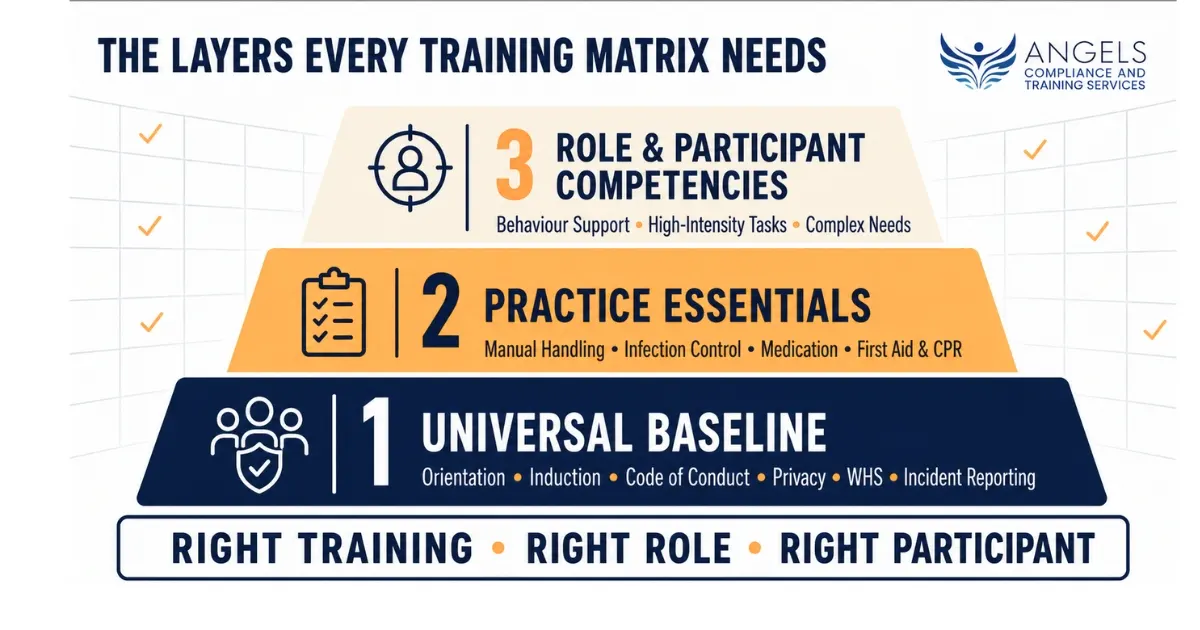
Not every worker needs every training item, and one of the most common mistakes providers make is either over-training everyone into fatigue or under-training the people who carry the most risk. The way through is to build your matrix in tiers, so requirements attach to roles and participants rather than being sprinkled uniformly across the whole team.
1. Layer one — the universal baseline
These apply to everyone delivering direct support, no exceptions. The NDIS Worker Orientation Module sits here, alongside your own organisational induction, the Code of Conduct, privacy and confidentiality, work health and safety fundamentals, and incident identification and reporting. This layer is where your induction program and your matrix meet: induction is the event, the matrix cell is the evidence that it happened and when it needs refreshing.
2. Layer two — the practice-implied essentials
These aren’t named as a checklist in the rules, but you cannot genuinely meet the standards without them once you deliver the relevant supports. Manual handling, infection prevention and control, medication awareness, and first aid and CPR typically live here. They’re driven by the nature of the support, not the individual participant.
3. Layer three — the role and participant-specific competencies
This is where the matrix earns its keep, because it ties training to actual service delivery rather than theory. A worker supporting a participant with a behaviour support plan needs training on that specific plan, including any regulated restrictive practices it authorises. A worker assisting with enteral feeding, tracheostomy care, or dysphagia-risk mealtimes needs documented high-intensity competency for that exact task. When a new participant with complex needs comes on board, this layer should trigger a fresh row of requirements and your matrix should flag any assigned worker who doesn’t yet meet them.
Structured this way, the matrix answers the question providers agonise over: “are we over-training or under-training?” not with a fixed list, but with logic. Each worker carries exactly the requirements their role and their participants generate. Nothing more, nothing missing.
Mapping Each Item to Its Standard
Here’s the step that separates a matrix that merely tracks training from one that produces audit evidence: every requirement in your grid should be mapped to the specific obligation it satisfies.
An assessor doesn’t just want to know a worker completed manual handling. They want to see that you understand why it’s required and that it connects to a standard. When each cell links to the relevant Practice Standard outcome Human Resource Management for competency, Incident Management for incident training, and the high-intensity provisions for complex supports you’ve transformed a workforce spreadsheet into a compliance map. You can hand an assessor a document that pre-empts their questions, because it already shows the reasoning they’d otherwise have to extract from you in an interview.
This mapping also protects you when standards evolve. When a requirement changes or a new obligation appears, a mapped matrix shows you immediately which rows are affected, rather than leaving you to guess which of your training items the change touches.
Keeping It Live: The Difference Between Two Audits
The 2026 compliance environment has made one expectation explicit: assessors increasingly want to see real-time compliance, not a snapshot assembled the week before the audit. A matrix that’s accurate only in the fortnight before an assessment isn’t a compliance system; it’s a performance.
The practical implication is that your matrix needs owners and rhythm. Someone must be responsible for updating it when training is completed, for reviewing expiry dates on a regular cadence, and for chasing completions before credentials lapse rather than after. A monthly review of the matrix checking what’s expiring in the next quarter and who’s overdue turns audit preparation from an event into a habit. Providers who embed this rhythm walk into audits with the evidence already assembled; those who don’t spend the lead-up in urgency mode, checking records and hoping nothing has quietly expired.
Auditors draw their evidence from four places: your documents, your records, what they observe in service delivery, and what your workers and participants tell them when asked directly. A live matrix strengthens the first two, and it quietly strengthens the fourth, because staff who’ve been genuinely and recently trained answer an assessor’s questions with confidence rather than hesitation. The document and the behaviour reinforce each other.
Common Failure Points to Design Out
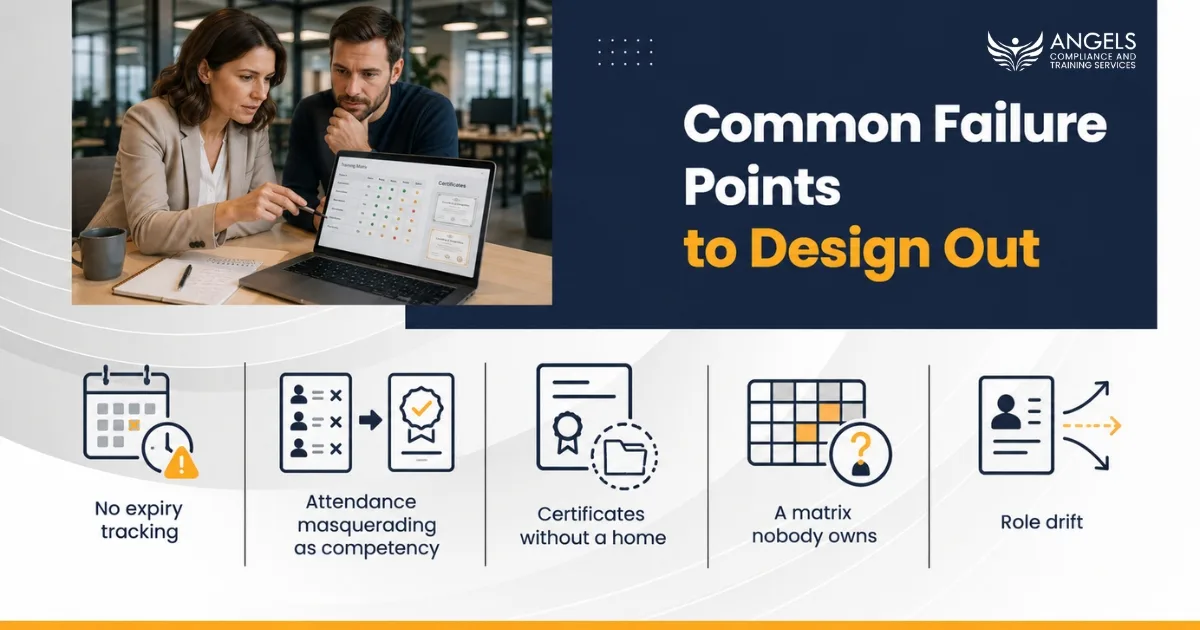
A few weaknesses appear again and again, and each one can be engineered out at the design stage:
- No expiry tracking. A matrix that records completion dates but not expiry dates will let credentials lapse silently. Every time-limited item needs a renewal date and an alert before it arrives.
- Attendance masquerading as competency. For higher-risk supports, a completion tick is insufficient. Build a separate competency-assessed status so the matrix distinguishes “attended training” from “assessed as competent.”
- Certificates without a home. The matrix should point to where each supporting certificate lives, so that when an assessor asks for proof of a specific entry, you can produce it in seconds rather than searching.
- A matrix nobody owns. Without a named owner and a review cadence, even a well-built matrix drifts out of date. Assign responsibility explicitly.
- Role drift. When a worker moves into supporting a participant with more complex needs, their training requirements change. The matrix has to be updated when assignments change, not only when training is delivered.
From Induction to Ongoing Assurance
A strong induction gives every new worker the right foundation: the principles, the boundaries, the confidence to deliver safe and respectful support from their first shift. But induction is a moment in time. Compliance is continuous. The training matrix is what carries the assurance forward, turning that strong start into a documented, defensible, always-current picture of your entire workforce’s competency.
Think of it as the connective structure of your quality system: it links the training you deliver, the standards you’re held to, and the evidence you’ll be asked to produce into a single view you can trust. Build it deliberately, map it to the standards, keep it live, and your next audit becomes a matter of showing what you already know to be true rather than proving something you hope you can find.
If your induction is solid but your evidence trail feels scattered, the fix usually isn’t more training. It’s a better system for capturing and proving the training you already do. That system starts with a well-designed matrix and a clear-eyed understanding that passing an audit was never about ticking the Orientation box. It was always about proving, in writing, that your workforce is ready.
Angels Compliance and Training Services helps NDIS providers across Perth and Australia-wide build audit-ready workforces from staff induction and orientation through to the compliance systems that keep your evidence current between audits. Get in touch to strengthen your training and compliance framework.