
Every NDIS participant’s plan carries a funding management type, and that one setting decides who pays your invoice, how fast the money lands and which pricing rules apply. Get it wrong at intake and you can deliver a month of excellent support, then spend the next month chasing a rejected claim.
This guide looks at the three NDIS plan management types from the provider’s side of the ledger. Our guide to how NDIS funding works explains how participants receive their funding. This one covers how NDIS providers get paid: where each invoice goes, what it must contain, when registration matters and which payment rules are changing under the new NDIS laws.
The Short Answer: Who Pays You Under Each Management Type
Under self-management, the participant pays you directly and then claims the cost from their plan. Under plan management, you invoice the participant’s plan manager, who claims from the NDIA and pays you. Under NDIA management (also called agency management), you claim directly from the NDIA through the myplace provider portal, and only registered providers can do so.
| Self-managed | Plan-managed | NDIA-managed | |
| Who pays you | The participant or their nominee | The participant’s plan manager | The NDIA |
| Where your invoice or claim goes | To the participant | To the plan manager | Payment request in the myplace provider portal |
| Registration needed? | No, except for supports that always require it | No, except for supports that always require it | Yes |
| Maximum prices apply? | No, price is agreed with the participant | Yes | Yes |
| Typical payment speed | Your agreed payment terms | Plan manager’s processing cycle plus NDIA release of funds | Usually 2 to 3 business days as a “my provider”, around 10 otherwise |
| Biggest payment risk | Late or missed payment by the participant | Invoice errors or pricing above the maximum | Portal errors, no my provider relationship, claim reviews |
One detail catches many new providers out: a single plan can mix management types. A participant might self-manage their capacity building supports while the NDIA manages their core supports. Always confirm the management type for the specific budget your service will be claimed against, not just the plan as a whole.
Why Management Type Is an Intake Question
The NDIA names an incorrect fund management type as one of the reasons claims are rejected, so this check belongs at intake, not in accounts.
Before the first shift, confirm which budget your support will draw from and how that budget is managed. Record the plan manager’s details if there is one, note the plan dates, and set out who is billed, how often and on what terms in your NDIS service agreement. Management type can change when a plan is reassessed or renewed, so re-check it at every plan change rather than assuming the old arrangement still stands.
Self-Managed Participants: You Invoice the Person, Not the Scheme
When you work with self-managed NDIS participants, your commercial relationship is with the participant or their nominee. You invoice them, they pay you, and they then claim the cost against their plan using your receipt or paid invoice.
Pricing is negotiated. The maximum prices in the NDIS pricing schedule apply only to NDIA-managed and plan-managed funding, so a self-managed participant can agree to a different price. Keep your rate defensible, consistent with what you charge other clients for the same service, and confirmed in writing. If the participant later moves to plan management, your price must come back within the maximum.
Registration is usually optional. Unregistered providers can deliver most supports to self-managed participants, apart from the supports covered further below that always need a registered provider.
You carry the credit risk. No plan manager or agency stands behind the invoice, so set clear payment terms, invoice promptly and agree upfront how overdue accounts will be handled.
Plan-Managed Participants: Send Every Invoice to the Plan Manager
For plan-managed participants, plan-managed invoices go to the participant’s plan manager, not to the participant. The plan manager, itself a registered NDIS provider, checks your invoice against the plan, lodges the claim with the NDIA and pays you once the funds are released. It must also keep your invoices and the records behind every claim it submits.
Your invoice needs a valid Australian Business Number. If you are exempt from quoting one, attach the Australian Taxation Office’s statement by a supplier form instead.
Maximum prices bind unregistered providers here too. The NDIA cannot pay a plan-managed claim above the maximum price for a support item, and providers cannot charge more than it. An invoice above the maximum will be queried, short-paid or rejected, however happy the participant is with your rate.
Turnaround varies. Each plan manager runs its own processing cycle, and some participants choose to approve invoices before they are paid. Build the plan manager’s turnaround plus the NDIA’s release of funds into your cash flow forecast.
Plan managers are about to change. Under the new NDIS laws, the NDIA will appoint a panel of plan managers and move participants to panel members over a six-month transition, after which plan managers outside the panel can no longer operate. Confirm each participant’s current plan manager before every billing cycle.
What a Claim-Ready NDIS Invoice Must Include
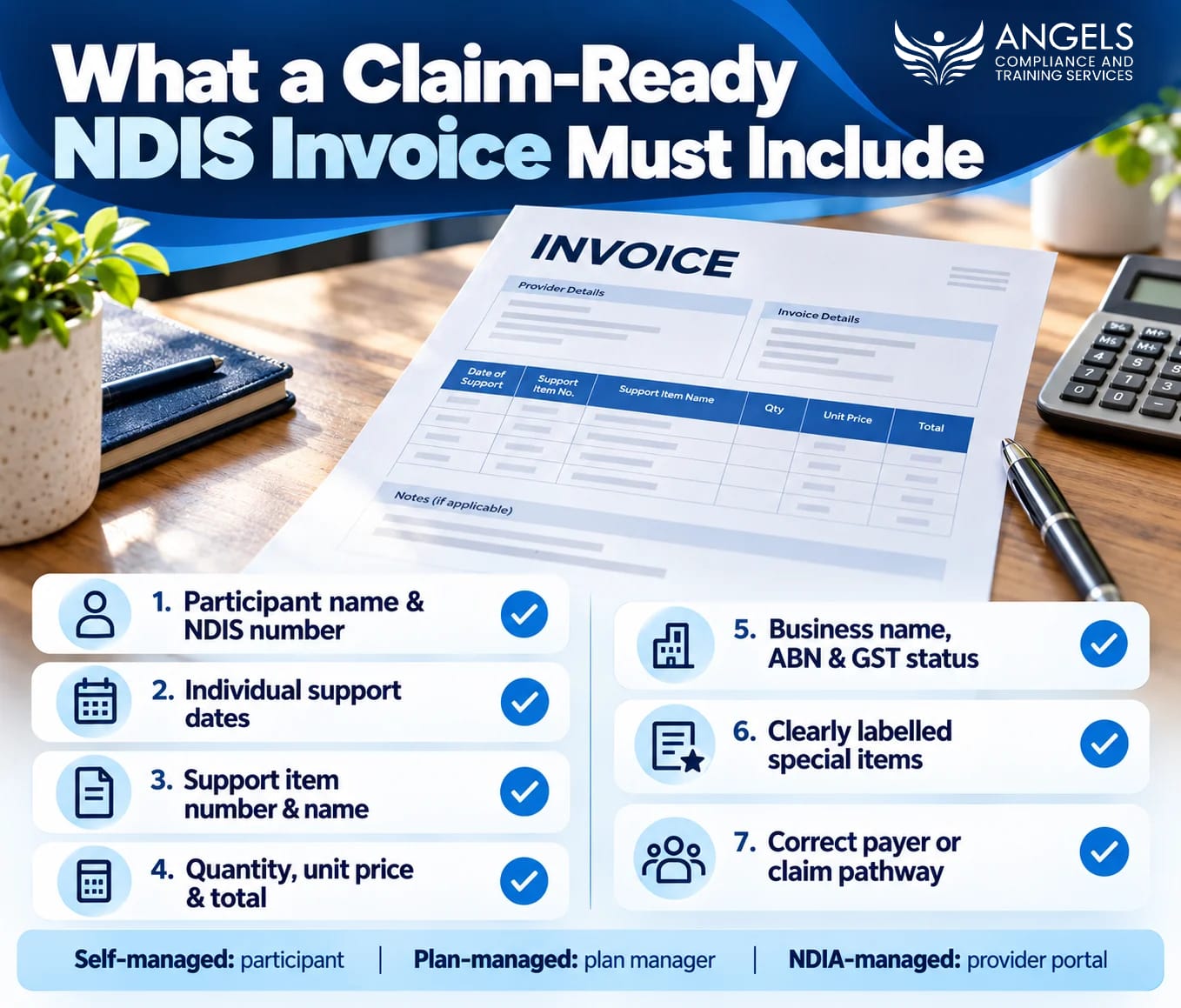
Whatever the management type, the NDIA needs the same core details to process a claim, and invoices that mirror those details attract fewer queries. A claim-ready NDIS invoice should include:
- The participant’s full name and NDIS number. These match the claim to the right plan. A transposed digit is one of the fastest routes to a rejection.
- The exact date of each support. List individual service dates rather than a month or a range, and make sure each one falls within the participant’s current plan period.
- The support item number and name. Copy both exactly from the current support catalogue. A retired or mistyped item number will fail validation.
- Quantity, unit price and total. For plan-managed and NDIA-managed funding, the unit price must sit at or below the current maximum. Our guide to applying NDIS price limits after registration shows how to keep line items compliant.
- Your business name, ABN and GST status. Plan managers need an active ABN before they can pay you, unless you are exempt and supply the ATO form instead.
- Clear labels on non-standard lines. Short-notice cancellations, provider travel and non-face-to-face time can only be claimed where the pricing rules and your service agreement allow it, so make these lines easy for the payer to identify.
- The right addressee. Self-managed invoices go to the participant, plan-managed invoices go to the plan manager, and NDIA-managed supports are claimed in the provider portal rather than invoiced. A perfect invoice sent to the wrong payer still waits.
NDIA-Managed Participants: Claim Directly Through the Provider Portal
Only registered providers can claim NDIA-managed funding. Instead of sending an invoice, you lodge an NDIA-managed payment request in the myplace provider portal. Every staff member who logs in needs their own myID, linked to your business through Relationship Authorisation Manager (RAM), which has replaced the old PRODA login.
The process depends on which NDIA computer system holds the participant’s plan. For plans in the older system, you need a service booking in place before you claim, and payment requests must be lodged within 90 days of that booking ending. For plans in the newer system, you need to be recorded as the participant’s my provider, and every claim goes through the bulk payment request upload.
Being a my provider has a direct effect on cash flow. The NDIA says valid claims from my providers are usually paid within two to three business days, while other claims, or claims it needs to check, take around ten business days. For specialist disability accommodation, home and living supports and behaviour supports, claims from providers who are not recorded as a my provider are rejected automatically. You can send a provider relationship request through the my NDIS provider portal for the participant to accept.
The NDIA can also review claims before or after payment. If it asks for more information, you have at least 14 business days to respond, and claims lodged more than six months after delivery may be held for a review lasting up to 28 days.
Registration: The Setting That Unlocks NDIA-Managed Funding
Unregistered providers can serve self-managed and plan-managed participants for most supports, but they cannot claim NDIA-managed funding. For growing providers, this is often where registration stops being optional: if many of the participants approaching you have agency-managed budgets, staying unregistered means turning them away.
Some supports need a registered provider however the plan is managed, including specialist disability accommodation, specialist behaviour support, regulated restrictive practices and plan management itself. Supported independent living and NDIS digital platform services have now joined that list, and the government has flagged mandatory registration for personal care, daily living and closed-setting supports as the next step. It is also consulting on expanding lower maximum prices for unregistered providers.
If you are weighing up whether registration makes financial sense for your participant mix, our NDIS registration support team can map your supports against the registration requirements and the audit pathway that would apply.
Payment Rule Changes to Prepare for Now
The Securing the NDIS for Future Generations legislation changes several rules that sit behind provider payments. Some are already in force and others are phasing in:
- Shorter NDIS claiming timeframes. Payment requests can currently be lodged up to two years after a support is delivered. From December, claims must be submitted within 90 days of delivery. If you invoice a plan manager or self-managed participant late, they may miss that window, so move to weekly or fortnightly billing if you haven’t already.
- Seven-year record keeping. Providers will need to keep records of supports and payments for seven years. Our NDIS policies and procedures service can help you formalise how shift notes, attendance records and invoices are stored and retrieved.
- Ministerial price setting. Maximum prices are now set by a ministerial pricing determination and published in the NDIS pricing schedule. Update your billing system whenever a new schedule takes effect, and agree any change to an existing service agreement with the participant first.
- Stronger compliance powers. The NDIA can automate some claims processing, require providers to supply information and issue civil penalties to those who don’t. Clean, consistent claim data matters more than ever.
- Budget reductions for some supports. Budgets for social, economic and community participation and for improved daily living skills are being reduced as plans are reassessed or renewed. Check remaining funds before you roster, because a claim against an exhausted budget won’t be paid.
Where Provider Payments Usually Go Wrong
In our audit compliance support work, payment problems rarely come down to one big mistake. They are small process gaps repeated across hundreds of claims: an intake form that never asks about management type, a price list that wasn’t updated when the schedule changed, shift notes that don’t match the hours claimed, or a departed staff member whose portal access was never reassigned. Auditors and NDIA payment reviewers look closely at exactly these links.
Treat billing as part of your compliance system. The evidence that proves a support was delivered safely should also prove it was claimed correctly.
How Angels Compliance and Training Services Can Help
Angels Compliance and Training Services supports NDIS providers across Australia from our base in Gosnells, Western Australia. We help providers decide when to register, prepare for audits, write claiming and record-keeping procedures that stand up to review, and train teams on the obligations attached to each funding arrangement. If your claims keep bouncing or you are getting ready to take on NDIA-managed participants, talk to our team about a practical review of your billing and compliance systems.
Frequently Asked Questions
Can an unregistered provider work with plan-managed participants?
Yes, for most supports. Plan managers can pay unregistered providers, but every invoice must stay within the maximum prices in the NDIS pricing schedule. Supports such as supported independent living and specialist behaviour support need a registered provider regardless of management type.
Do NDIS price limits apply to self-managed participants?
No. The maximum prices apply only to NDIA-managed and plan-managed funding. Self-managed participants can negotiate prices with providers, although providers should keep their pricing fair, consistent and documented.
How long does the NDIA take to pay a provider claim?
Valid NDIA-managed claims from a participant’s recorded my provider are usually paid within two to three business days. Other claims, or claims the NDIA needs to check, can take around ten business days.
What is a “my provider” in the NDIS?
A my provider is a provider recorded against a participant’s plan in the NDIA’s newer computer system. The relationship speeds up NDIA-managed payments and is required for claims for specialist disability accommodation, home and living supports and behaviour supports.
How long do providers have to submit an NDIS claim?
Currently up to two years after a support is delivered, or within 90 days of a service booking ending for NDIA-managed plans in the older system. Under the new NDIS laws, claims must be submitted within 90 days of delivering a support from December.
Can one participant use more than one management type?
Yes. A plan can combine management types across budgets, such as NDIA-managed core supports alongside self-managed capacity building supports. Confirm the management type for the budget you will claim against before you start delivering.