

For most therapy providers, the headline out of the 2026-27 Annual Pricing Review was the rate movement: psychology up, dietetics and exercise physiology down, occupational therapy and speech pathology held. But the change that will actually reshape how you invoice from 1 July 2026 isn’t a number on a rate card. It’s structural. The NDIA has taken the activities that used to sit inside a single therapy session- travel, report writing, indirect work, telehealth, cancellations- and pulled each one out into its own line item with its own code.
If your billing still treats a therapy appointment as one claim, it is now built the wrong way. This is the part of NDIS therapy pricing 2026 that quietly determines whether your claims get paid, and it’s the part most providers underestimate. This article walks through the split itself: the six line items per discipline, the suffix logic, where the revenue genuinely shifts, and what has to change in your systems before your next claim goes in.
A quick note on scope: this piece assumes you already know the Price Guide was replaced by the NDIS Pricing Schedule on 1 July 2026. If you need that background, the terminology change, the headline rate table, the same-week compliance checklist, read our companion article, The New NDIS Pricing Schedule Explained. Here we go deep on one thing only: the line-item split and what it does to therapy billing.
The old model vs the new model
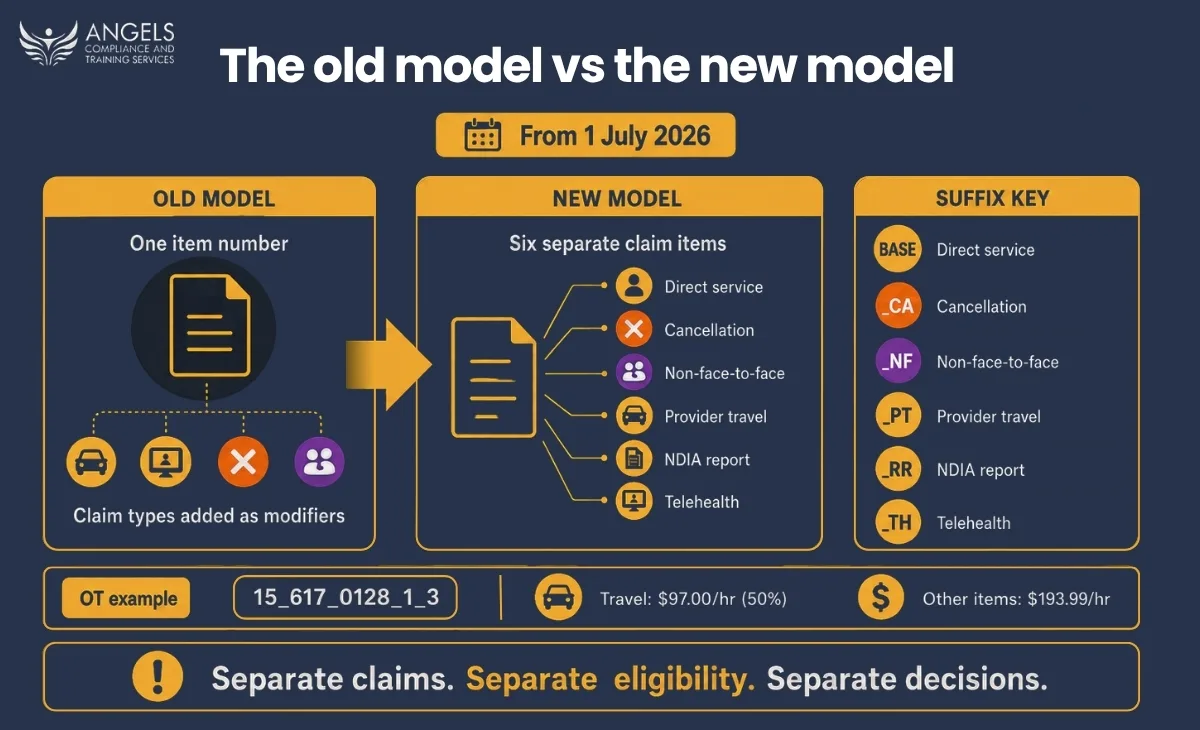
Under the previous arrangements, a therapy service was largely claimed as a single support with a “claim type” attached to flag things like travel, telehealth, cancellations, or non-face-to-face time. One item number carried the session, and the extras were modifiers hanging off it.
From 1 July 2026, that claim-type system is gone for allied health. In its place, each therapy discipline now carries six distinct support items, each formed by adding a suffix to the base item number:
- Direct service — the base item, no suffix
- _CA — cancellation/no-show
- _NF — non-face-to-face (participant-specific indirect work)
- _PT — provider travel (labour time only)
- _RR — NDIA-requested reports
- _TH — telehealth (live remote session)
So an occupational therapy session that used to be one line can now legitimately generate up to six different item numbers depending on what was delivered. The base OT item and its family look like this:
| Activity | Item number | National price |
| Direct service | 15_617_0128_1_3 | $193.99/hr |
| Cancellation | 15_617_0128_1_3_CA | up to $193.99/hr |
| Non-face-to-face | 15_617_0128_1_3_NF | $193.99/hr |
| Provider travel | 15_617_0128_1_3_PT | $97.00/hr (50%) |
| NDIA-requested report | 15_617_0128_1_3_RR | $193.99/hr |
| Telehealth | 15_617_0128_1_3_TH | $193.99/hr |
The same suffix structure now applies discipline by discipline across allied health. The important shift is conceptual: these are no longer “extras” bolted onto a session; they are separate claims, each with its own eligibility conditions, each of which can be rejected on its own merits.
The five suffixes, and the line where each one goes wrong
The reason this matters for compliance is that each suffix has its own rules about when it can and can’t be used. Getting the code right is not a formatting exercise; it’s the difference between a paid claim and a flagged one. Here’s how the NDIA’s claiming logic actually reads for each.
1. _CA — Cancellation
Use this when a scheduled session would have been delivered under the direct-service item, but the participant cancelled inside the short-notice window or didn’t attend. For therapy, “short notice” is generally less than two clear business days (support-worker services use a seven-day rule). You can claim up to 100% of the agreed fee, but only where the cancellation policy is written into the service agreement, the participant gave insufficient notice, and you couldn’t fill the slot with other billable work. If you employ the therapist, you must still be paying them for that time.
Where it goes wrong: claiming _CA when the participant simply rescheduled, when adequate notice was given, or when the slot was refilled. A rescheduled appointment is not a cancellation.
2. _NF — Non-Face-to-Face
Use this for participant-specific indirect work that is a genuine part of delivering the support, analysing that participant’s assessment results, preparing their individual intervention, writing up a progress summary that the NDIA didn’t specifically request. It must be tied to an identified participant, agreed in advance, and the quantity claimed must reflect the actual work done.
Where it goes wrong: treating general business admin as _NF, rostering, service bookings, invoicing, entering client details, staff training and supervision are overheads baked into the support price; they are not claimable indirect time. This is the suffix most likely to be scrutinised in an audit, because the line between “participant-specific clinical work” and “running your business” is exactly where over-claiming happens.
3. _PT — Provider Travel
Use this for the labour-time component of travelling to deliver a face-to-face session. For therapy, travel time is priced at 50% of the direct rate, $97.00/hr against the $193.99/hr OT rate. Time limits apply: generally up to 30 minutes each way in metro (MMM1-3) areas and up to 60 minutes each way in regional (MMM4-5) areas, with different arrangements for remote and very remote.
Where it goes wrong: two traps. First, claiming _PT on a telehealth session; there is no travel to a video call. Second, using _PT for vehicle costs. The PT item is time only. Kilometres, tolls, parking, flights and accommodation go under the separate provider-travel non-labour item (the 15_799 family), not here.
4. _RR — NDIA-Requested Reports
Use this only when the NDIA itself has required the report, a plan-commencement report, a plan-review functional-outcomes report, or a report specifically stipulated in the participant’s plan. The participant must have agreed in advance that these costs can be charged.
Where it goes wrong: assuming any report is _RR. A report requested by a support coordinator, plan manager, GP, family member or another provider is not an NDIA-requested report. It may qualify as _NF if it’s participant-specific and agreed in advance, but it does not belong under _RR. This distinction catches a lot of providers who read “report” and reach for the reports code by reflex.
5. _TH — Telehealth
Use this where the direct session itself is delivered live and remotely, via real-time video or an appropriate remote clinical method, and telehealth claiming is agreed in the service agreement.
Where it goes wrong: confusing _TH with _NF, a live remote session with the participant is _TH. Preparation, documentation or report writing done without the participant present is _NF. If the participant isn’t on the call, it isn’t telehealth.
Where the revenue actually moves
The line-item split is often described as “just admin.” It isn’t, because it interacts with two rate realities that change what a full week of therapy is worth.
Travel is the pressure point. Provider travel time is claimed at 50% of the direct rate. For a home- and community-based caseload a lot of paediatric OT, a lot of rural speech pathology travel is a material share of the working day, and every one of those hours is now visibly billed at half rate on its own line. It was always priced this way; what’s new is that the split makes the economics impossible to ignore. If your model depends on travel-heavy delivery, this is the moment to actually calculate the revenue impact per clinician, not estimate it.
The rate movements land on top of the split. Because the NDIA now benchmarks each discipline against comparable non-NDIS pricing rather than lifting everything uniformly, the disciplines don’t move together:
- Psychology rose to $252.99/hr (up from $232.99).
- Dietetics fell to $178.99/hr (from $188.99).
- Exercise physiology fell to $161.99/hr (from $166.99).
- Occupational therapy, speech pathology, physiotherapy, podiatry and audiology were held.
- Orientation and Mobility Specialists are newly recognised with their own item at $156.16/hr.
For a multidisciplinary practice, that means two different clinicians can see their effective hourly earnings move in opposite directions this year before you even factor in how much of each one’s week is travel and indirect time now sitting on separate, differently-priced lines.
Why the NDIA built it this way — and what’s coming
It’s worth understanding the intent, because it tells you where this is heading. By forcing telehealth, non-face-to-face and travel onto their own line items, the NDIA is generating claim-level data on how therapy is actually delivered and at what cost. A phone consult and a piece of report writing cost less to provide than an hour of in-person clinical time, and the split is how the evidence for differentiated pricing gets built.
The three-year pricing workplan already lists a therapy pricing review, with differentiated rates among its stated focus areas. The most widely expected next step is separate, lower rates for telehealth and non-face-to-face time. In other words, today the _TH and _NF items are priced the same as direct service, but the line-item structure is precisely the mechanism that would let that change in a future review. Building your billing to itemise cleanly now isn’t only about this year’s compliance; it’s about not being caught flat-footed when those rates diverge.
What this means for your billing system rebuild
Because the split is live, this is a same-week task, not a plan-for-later one. Practically, the therapy billing rebuild involves:
a. Load the full item family, not just the base item
For every discipline you deliver, your software needs all six items configured base plus _CA, _NF, _PT, _RR, _TH — with the correct national (and, where relevant, remote/very-remote) prices, including the 50% travel rate on the _PT line. Loading only the direct-service item is the single most common way to end up with rejected claims.
b. Separate the lines on the invoice
A session with travel and follow-up indirect work is now three claim lines, not one session with modifiers. Your invoice templates and claim exports need to produce discrete lines with the right suffix and the right quantity (travel and NF2F are typically fractional-hour quantities).
c. Fix the travel item confusion at the source
Make sure your team knows PT is time-only and that kilometres/tolls/parking route to the separate 15_799 non-labour item. This is a training issue as much as a software one.
d. Update service agreements to authorise each chargeable component
Cancellation charging, telehealth, provider travel, NF2F work and NDIA-requested reports all require prior agreement with the participant. If your service agreement doesn’t explicitly cover a component, you can’t compliantly claim its suffix, and you can’t change agreed prices unilaterally. Agreements have to be revisited, not assumed.
e. Re-check quotes and standing bookings
So nothing is still quoting a bundled, pre-split rate. Each of these is a point where a claim can be rejected or an auditor can find a gap. The split doesn’t just change what you claim; it multiplies the number of places a claim has to be right.
Getting it right the first time
The 2026 line-item split is deceptively large. On paper it’s “add a suffix”; in practice it changes your invoice structure, your service agreements, your travel policy, your clinician training and your exposure at audit all at once, and all against live prices. Configure the item families correctly, itemise every component as its own line, hold the suffix rules firmly (especially the _NF and _RR boundaries), and update your agreements so every chargeable component is authorised, and this becomes a clean transition rather than a run of rejected claims.
This is exactly the kind of behind-the-scenes change that quietly surfaces at your next audit if it wasn’t handled properly at the start. At Angels Compliance and Training Services, we help NDIS providers align billing to the new Pricing Schedule, update service agreements with proper participant agreement, and make sure the documentation stands up when it’s reviewed. If you’d like confidence that your therapy billing, agreements and compliance are right for 2026-27, book a free consultation with our team.
Frequently asked questions
1. How many line items does each therapy discipline have under NDIS therapy pricing 2026?
Six: the direct-service base item plus five suffixed items — _CA (cancellation), _NF (non-face-to-face), _PT (provider travel), _RR (NDIA-requested reports) and _TH (telehealth). Each is claimed separately with its own eligibility conditions.
2. What is the difference between the _NF and _TH codes?
_TH is a live, real-time remote session delivered with the participant present (for example, a video appointment). _NF is participant-specific indirect work done without the participant present, such as analysing their assessment or preparing their individual program. If the participant is not in the session, it is not telehealth.
3. Is provider travel really claimed at half the therapy rate?
Yes. For therapy and early childhood therapy, provider travel time on the _PT line is generally capped at 50% of the direct-service price for occupational therapy; that’s $97.00/hr against the $193.99/hr direct rate. The _PT item covers labour time only; kilometres, tolls and parking use the separate non-labour travel item.
4. Can I claim _RR for any report I write?
No. _RR applies only where the NDIA itself has required the report, typically a plan-commencement report, a plan-review outcomes report, or a report stipulated in the plan. A report requested by a support coordinator, plan manager, GP, family member or another provider is not _RR, though it may qualify as _NF if it is participant-specific and agreed in advance.
5. Do I need to update participant service agreements because of the split?
Yes. Cancellation charging, telehealth, provider travel, non-face-to-face work, and NDIA-requested reports each require prior agreement with the participant. If a chargeable component isn’t covered in the service agreement, you can’t compliantly claim its suffix and agreed prices can’t be changed unilaterally.
6. Which therapy disciplines changed price in 2026-27?
Psychology rose to $252.99/hr; dietetics fell to $178.99/hr and exercise physiology to $161.99/hr; occupational therapy, speech pathology, physiotherapy, podiatry and audiology were held; and Orientation and Mobility Specialists were newly added at $156.16/hr. The line-item split applies across disciplines regardless of whether the direct rate moved.
This article reflects information available as of August 2026, based on the NDIA’s 2026-27 Annual Pricing Review and NDIS Pricing Schedule effective 1 July 2026. Specific prices, item numbers and claiming rules may change, and not every support item permits every claim type. For authoritative detail, refer to the official NDIS Pricing Schedule and Support Catalogue at ndis.gov.au, and speak with us about your specific circumstances.