

You delivered the support. The participant was happy, your worker wrote clear notes, and the invoice went out on time. Then the claim came back rejected, or a plan manager asked you to reissue it against a different line item. For many providers, the cause is not the service itself but the budget it was billed against.
Understanding how participant funding is structured is one of the most practical skills a provider can build. It protects your cash flow, keeps participants’ funds intact for the supports they actually need, and gives auditors confidence that your billing practices are sound. At Angels Compliance and Training Services, billing against the wrong budget is a recurring issue we see when reviewing provider systems during audit preparation, so this guide walks through how the structure works and how to claim correctly every time.
How a Participant’s Plan Is Structured
Every NDIS plan is built in layers. At the top are support purposes, often called budgets. Beneath those sit support categories, and beneath the categories sit individual support items, each with its own item number and price limit.
The National Disability Insurance Agency (NDIA) describes three main support purposes: Core, Capital and Capacity Building. Some plans also show a separate allocation for transport. Within those budgets, supports are grouped into categories that link back to the NDIS outcomes framework. The legacy system used 15 categories, and the newer PACE system expanded that list so funding can be described more precisely.
Each category contains support items listed in the NDIS Pricing Arrangements and Price Limits and the accompanying Support Catalogue. These documents tell you which item number to claim, the maximum price you can charge, and any special rules such as quoting requirements or claiming conditions. Importantly, the prices listed are ceilings, not set rates.
When you understand these NDIS budget categories and how they nest together, you can read a participant’s plan and quickly see what you are able to deliver, what funding is available, and where your claim needs to land.
The Three Main Budgets Every Provider Should Understand
Each budget has its own purpose and its own rules about how funds can move. Here is what providers need to know about each one.
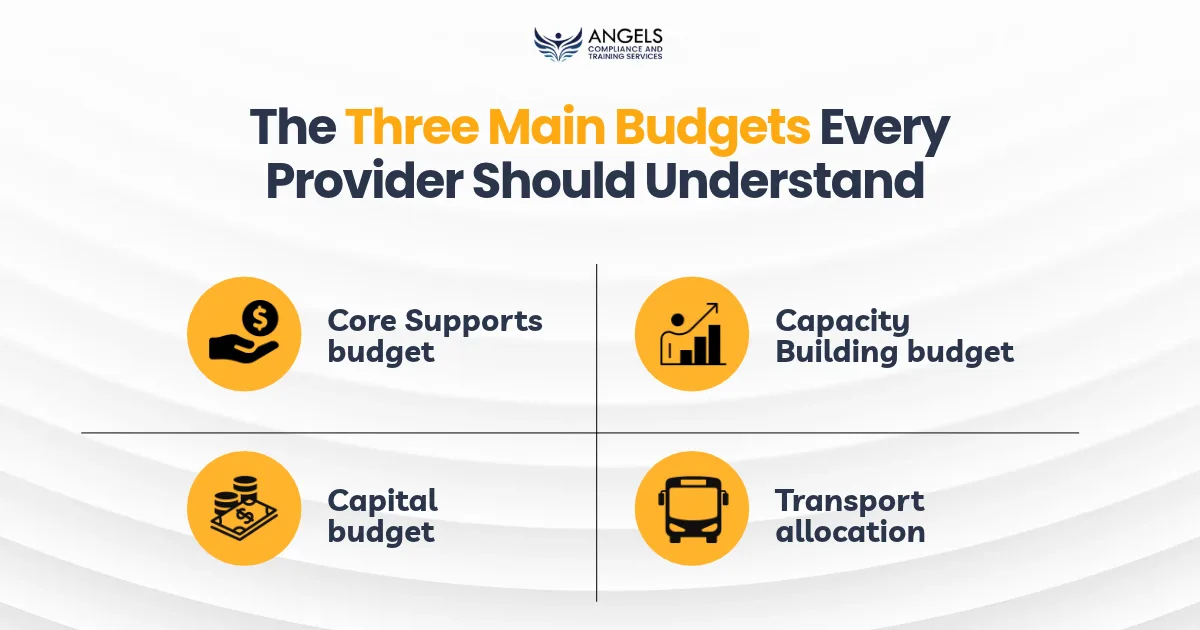
a. Core Supports budget:
Core funding helps participants with everyday living, such as assistance with daily personal activities, household tasks, consumables and support to take part in social and community activities. It is often the most flexible budget. In many plans, funds can be used across several core categories, which gives participants more choice. However, some core categories are stated, meaning the funding is tied to a particular support and cannot be redirected. Before you assume flexibility, check how each category appears in the participant’s plan.
b. Capacity Building budget:
This budget funds supports that build a participant’s skills and independence over time. Examples include therapy, support coordination, improved daily living skills, finding and keeping a job, and help with relationships or health and wellbeing. Funding here is generally allocated to a specific category and is far less flexible than core funding. If a participant has funding for therapy, for example, it cannot simply be used to pay for community access. Allied health providers should be especially careful here, because therapy items are commonly billed against the wrong category.
c. Capital budget:
Capital funding covers investments such as assistive technology, equipment, home modifications, vehicle modifications and Specialist Disability Accommodation. These supports are usually stated and tied to a specific purpose. Many higher-cost items require a quote and NDIA approval before purchase. Claiming against capital funding without the right approval or evidence is a fast way to have a payment reversed.
d. Transport allocation:
Where a plan includes transport funding, it is intended to help participants travel to work, study or community activities. Depending on the plan and how it is managed, this may be paid directly to the participant rather than claimed by a provider. Always confirm the arrangement rather than assuming you can claim it.
Knowing these differences helps your team ask the right questions at intake and avoid promising supports the participant’s plan cannot fund.
Flexible Funding, Stated Supports and Why They Matter
Recent legislative reforms have changed how plans are described. Plans now show a total funding amount, the amounts for each funding component, and funding periods that determine how much money is released over time. A participant may have enough funding across the life of the plan, yet still run short within a single funding period if supports are front-loaded.
The NDIA is also gradually moving participants to new framework plans. According to the Department of Health, Disability and Ageing, these plans are built after a support needs assessment and are made up of flexible funding, which can be used across a range of NDIS supports, and stated supports, which must be used as specified. During the transition, providers will work with participants on both old and new plan types at the same time.
There is also a clear boundary around what can be funded at all. Participants can only use their funds on supports that meet the definition of NDIS supports, so a service that falls outside that list cannot be claimed regardless of which budget has money left in it. This is why NDIS claiming compliance now depends as much on understanding plan structure as it does on accurate invoicing.
For providers, the practical takeaway is simple: never rely on last year’s understanding of a participant’s plan. Check the current plan, its funding periods, and any stated supports before you schedule services.
A Step-by-Step Approach to Claiming Against the Right Budget
A consistent claiming process reduces errors and makes your billing easy to defend at audit. These steps form a strong foundation.
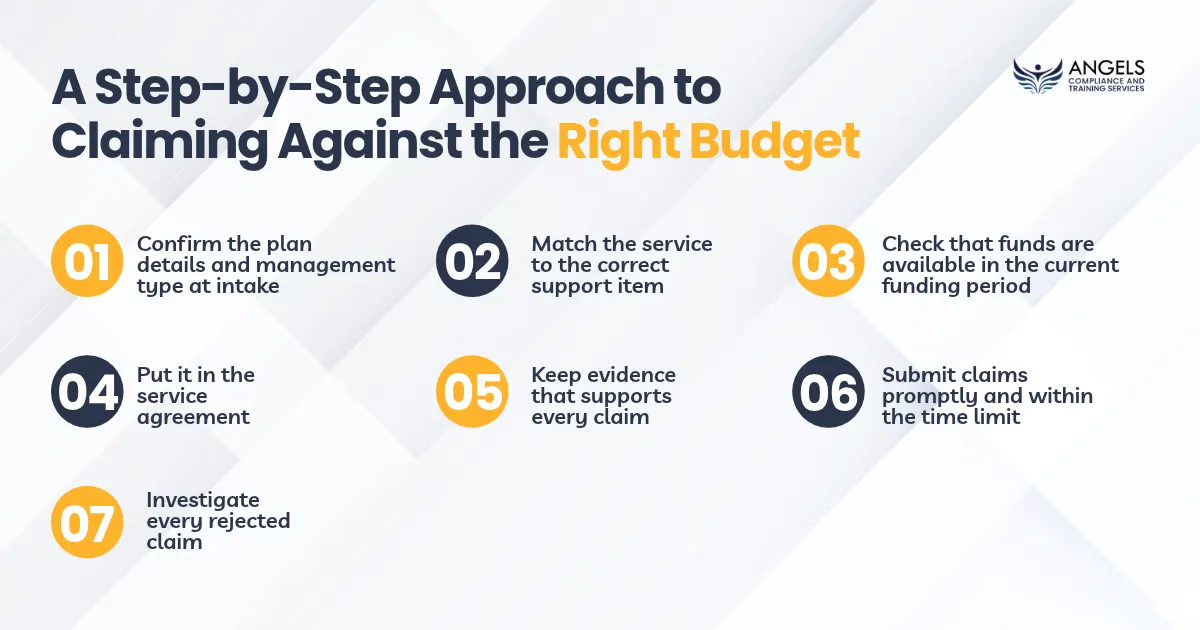
1. Confirm the plan details and management type at intake
Record the plan dates, funding periods, and whether the participant is NDIA-managed, plan-managed or self-managed. The management type decides who pays you and which claiming channel you use. Our guide to self-managed, plan-managed and NDIA-managed provider payments explains how each one affects your invoices.
2. Match the service to the correct support item
Look up the item in the current Pricing Arrangements and Price Limits and confirm that its support category sits within a budget the participant actually holds. The item number should reflect what was delivered, not simply what has funding available.
3. Check that funds are available in the current funding period
A plan with a healthy total can still have little left in the current period. Checking before delivery prevents claims that cannot be paid.
4. Put it in the service agreement
Your service agreement should state the supports, the item numbers, the agreed price and the budget they draw from. This gives the participant clarity and gives you written evidence if a claim is questioned.
5. Keep evidence that supports every claim
Shift notes, timesheets, travel records and progress notes should line up with the date, duration and type of support claimed. Auditors routinely test claims against records.
6. Submit claims promptly and within the time limit
Claims must now be made within two years of the support being delivered, but waiting that long is risky. Regular claiming keeps your records fresh and your cash flow steady. For more practical tips, see our article on NDIS invoicing and getting paid faster.
7. Investigate every rejected claim
Treat each rejection as a signal. Identify the cause, correct the claim, and update your process so the same error does not repeat.
Common Budget Mistakes That Lead to Rejections and Audit Findings
Most budget errors are avoidable. The ones we see most often include billing capacity-building supports to core funding because core had more money left, claiming items without the required quote or approval, using outdated item numbers after annual pricing updates, and charging above the price limit. Another frequent issue is claiming travel or non-face-to-face time without meeting the specific conditions set out in the pricing rules.
These mistakes matter beyond a single payment. Repeated incorrect claiming can raise questions about your governance and financial management, which form part of the NDIS Practice Standards that registered providers are audited against. Using participant funds incorrectly also reduces the support available to them, which is a quality and safeguarding concern as well as a financial one.
Building Correct Claiming Into Your Compliance Framework
The most reliable way to claim correctly is to make it part of your systems rather than leaving it to individual staff. That means having documented billing and service agreement procedures, training intake and finance staff to read plans properly, and reviewing claims regularly against plans and records.
A well-written set of NDIS policies and procedures gives your team a clear process to follow, while an independent internal audit and audit preparation review can identify billing weaknesses before an external auditor does. For teams that want hands-on guidance, NDIS compliance coaching helps managers and staff build confidence in applying the rules day to day. Strong NDIS provider compliance in this area reflects a business that respects participants’ funding and manages it responsibly.
Claim With Confidence
Reading a participant’s plan correctly is the foundation of accurate billing. When your team understands how budgets, categories and support items connect, and checks funding periods and stated supports before delivery, rejected claims become the exception rather than the routine.
If you would like support reviewing your claiming processes, service agreements or audit readiness, contact the Angels Compliance and Training Services team to discuss how we can help your organisation stay compliant and financially secure.
Disclaimer: This article provides general information only and does not constitute legal, financial or professional advice. NDIS pricing, planning rules and claiming requirements change regularly. Always check the current NDIS Pricing Arrangements and Price Limits, the participant’s plan and official NDIA and NDIS Commission guidance, or seek professional advice for your specific circumstances.