

Every allied health team we coach eventually asks the same question, usually after a plan comes back with half the therapy hours they asked for: what did we do wrong?
Nine times out of ten, the assessment itself was sound. The clinician saw the participant, ran the right standardised tools, understood exactly why the person needed the support. What let them down was the document. The findings were buried under three pages of diagnostic history, the recommendations weren’t tied to the criteria a delegate has to apply, and the funding table listed hours without ever explaining what those hours were meant to change.
A well-written functional capacity report is not a clinical summary with a wish list stapled to the end. It is a piece of decision-ready evidence written for a specific reader who has limited time, a legislated test to apply, and no clinical background. Once your team writes with that reader in mind, plan outcomes improve often dramatically, and usually without a single extra hour of assessment time.
This guide sets out what the NDIA actually looks for, what is shifting in the planning process right now, and a repeatable structure your clinicians can use from Monday.
What a functional capacity report is supposed to prove
A functional capacity assessment report exists to answer one question: how does this person’s impairment affect what they can do in everyday life, and what supports would change that?
The National Disability Insurance Agency asks treating professionals for evidence that is recent, comes from the most appropriate professional, confirms which impairments result in disability, describes previous treatment and outcomes, and explains likely future treatment options. Critically, it also has to describe the impact of the disability across different areas of life. The NDIA sets out six functional domains it works with: mobility, communication, social interaction, self-care, self-management, and learning in its published guidance on supporting evidence for health professionals.
Those six domains are the skeleton of your report. If a delegate can’t quickly locate what the participant can and cannot do in each domain, the document is doing half its job.
The second half is the funding argument. Every support recommended in an NDIS plan must satisfy the reasonable and necessary test in section 34 of the National Disability Insurance Scheme Act 2013. In plain terms, the support must help the participant pursue their goals, facilitate social and economic participation, represent value for money, be likely to be effective and beneficial, account for informal supports from family and community, and be appropriately funded by the NDIS rather than another service system such as health or education.
Here’s the part most clinicians miss: nobody expects the delegate to infer any of that. If your report doesn’t explicitly connect a recommendation to those criteria, the delegate has to make the case for you, and delegates under time pressure rarely do.
Why documentation quality matters more under New Framework Planning
There is a genuine shift underway in how plans are built, and it changes how much weight your report carries.
The NDIA is progressively introducing New Framework Planning, starting with a small group of participants and expanding in stages. At its centre is a support needs assessment: a guided conversation between the participant and a trained NDIS assessor, who then submits a formal assessment report that the Agency uses to build the plan budget. Participants aged 16 and over will transition gradually, and the Agency has confirmed plans will continue to be approved by trained staff rather than an automated system. The NDIA’s update on the new way of planning and the Department of Health, Disability and Ageing’s new framework planning rules page are the two sources worth bookmarking.
The practical consequence for providers is this: the participant now walks into a structured conversation, and the quality of the documentation they bring shapes how well that conversation goes. A vague report leaves the participant to explain their own functional limitations under pressure. A precise one gives them and the assessor concrete, specific language to work from.
We’d also note that funding scrutiny has tightened across the board. If you deliver therapy supports, our breakdown of what the new NDIS line-item split means for allied health providers is worth reading alongside this article, because report writing time and its billing treatment are directly affected.
The eight building blocks of a report that gets funded
This is the structure we teach in our report-writing sessions. It maps cleanly to how a delegate reads, and it works for occupational therapists, physiotherapists, speech pathologists, and psychologists alike.
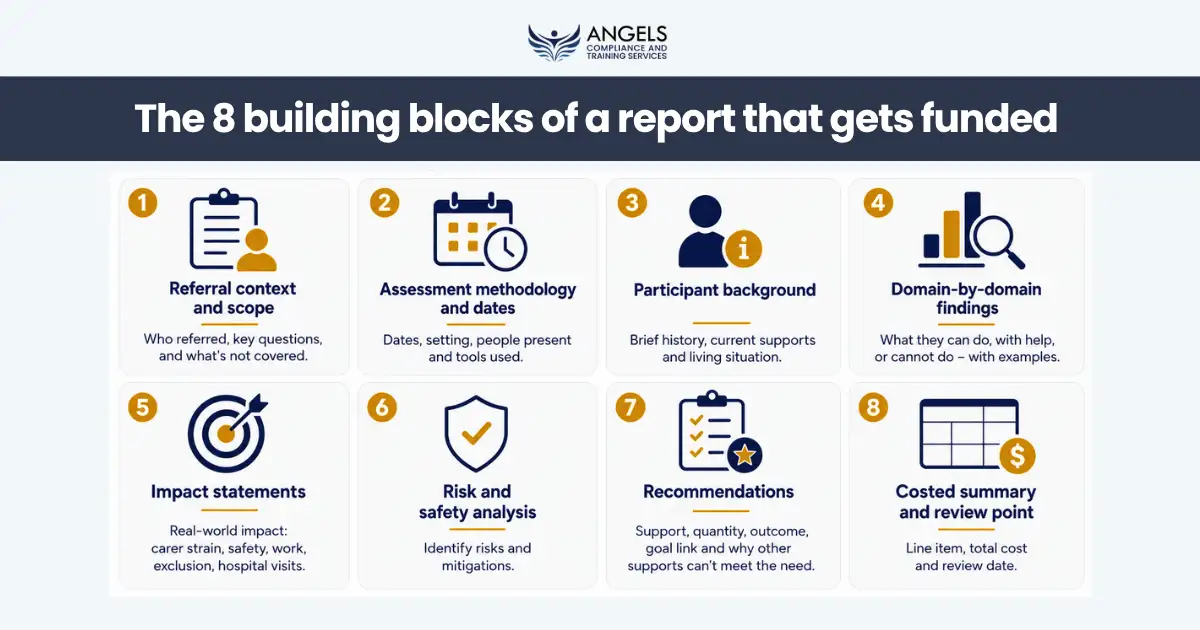
1. Referral context and scope, stated up front. Open with who referred the participant, what specific questions the assessment was asked to answer, and what the report does not cover. This single paragraph prevents the most common rejection reason: a report that reads as though it wandered outside the clinician’s scope of practice. It also protects you at audit, because it evidences that the service delivered matched the service agreed.
2. Assessment methodology and dates. List every contact: dates, duration, setting (home, clinic, school, workplace), who was present, and every standardised tool administered with its full name and version. Home-based observation carries more weight than clinic-based self-report, so say where you were. Undated reports are treated as stale, and “recent” is an explicit NDIA expectation.
3. Participant background kept short and functional. Two to three paragraphs. Diagnosis, relevant history, current supports, living situation, and who provides informal assistance. Resist the urge to reproduce the full medical file. The delegate is not assessing the diagnosis; they are assessing function. A long history section pushes your findings below the fold.
4. Domain-by-domain functional findings. Use the six NDIA domains as your headings. Under each, state what the person can do independently, what they can do with assistance, and what they cannot do, with observed examples and, where you have them, frequency and duration. “Requires physical assistance for lower-body dressing, approximately 25 minutes each morning, seven days a week” tells a delegate something. “Difficulty with dressing” does not.
5. Impact statements that quantify the gap. For each significant limitation, write one sentence describing the real-world consequence: missed work, carer strain, safety risk, exclusion from community activity, hospital presentations. This is where you demonstrate why the limitation matters, not just that it exists.
6. Risk and safety analysis.Falls, choking, wandering, medication errors, financial exploitation, escalating behaviours of concern. Where behaviour support is relevant, be careful to stay inside your role and refer to our guidance on behaviour support plans and restrictive practices, which explains where those boundaries sit. Documented risk with a documented mitigation is one of the strongest arguments in any report.
7. Recommendations mapped to the reasonable and necessary criteria. For each recommended support, state the support, the quantity, the expected outcome, the goal it links to, and why it is value for money. Then say plainly why informal supports and mainstream services cannot meet the need. Six recommendations argued this way beat twenty listed as bullet points.
8. A costed summary table and review point.Line item, hours or units, unit description, total, and a stated review date. Give the delegate the arithmetic. Then tell them when the recommendation should be retested; a defined review point signals clinical rigour and makes the request easier to approve.
Two rewrites that show the difference
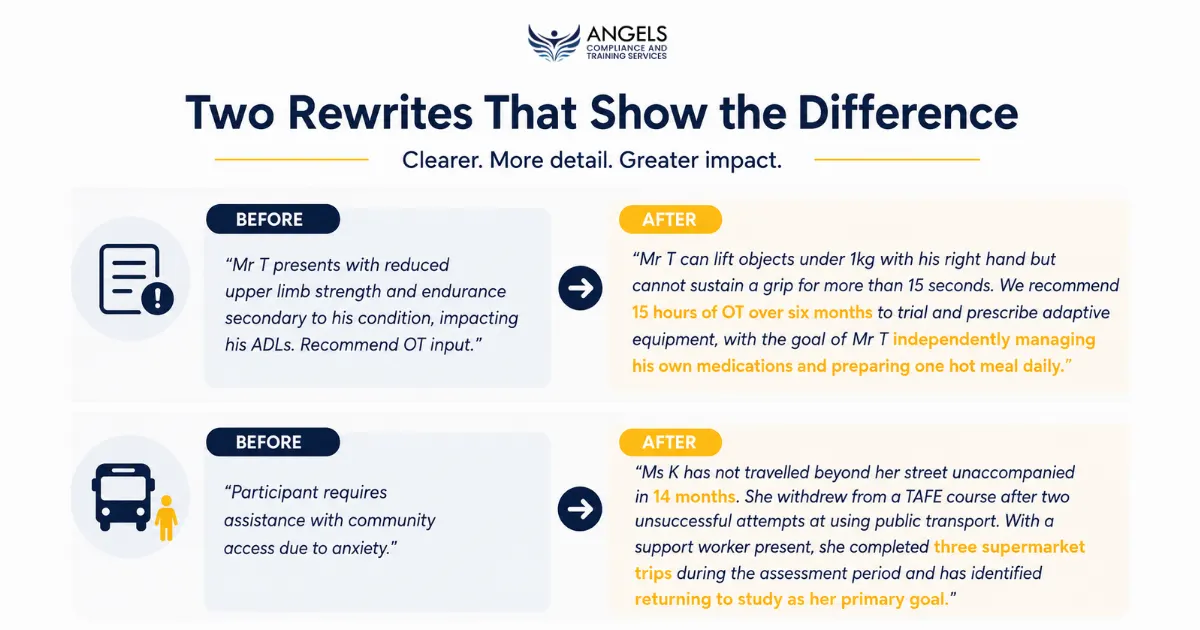
Nothing makes this clearer than seeing the same finding written twice.
Before: “Mr T presents with reduced upper limb strength and endurance secondary to his condition, impacting his ADLs. Recommend OT input.”
After: “Mr T can lift objects under 1kg with his right hand but cannot sustain a grip for more than about 15 seconds. Observed at home, he was unable to open his medication blister packs, drain a pot of pasta, or hang washing without assistance. His wife currently completes these tasks, adding roughly 90 minutes to her day; she works four days a week and reports she can no longer sustain this. We recommend 15 hours of occupational therapy over six months to trial and prescribe adaptive equipment and retrain technique, with the goal of Mr T independently managing his own medications and preparing one hot meal daily. Equivalent paid support to cover these tasks would cost substantially more across a plan year, and no mainstream service provides this intervention.”
Same clinician, same participant, same assessment. The second version answers the delegate’s questions before they are asked: what is the limitation, how do we know, who is absorbing the gap now, what will change, and why is this the sensible way to fund it.
Before: “Participant requires assistance with community access due to anxiety.”
After: “Ms K has not travelled beyond her street unaccompanied in 14 months. She withdrew from a TAFE course after two unsuccessful attempts at using public transport. With a support worker present, she completed three supermarket trips during the assessment period. She has identified returning to study as her primary goal.”
The second version is not longer for the sake of it. Every added clause is a fact a delegate can weigh.
The compliance layer providers keep forgetting
Report writing is a clinical activity, but it is also a governance one, and the two are assessed together.
The NDIS Practice Standards require registered providers to keep accurate, complete records of the supports they deliver and to have systems that back that up. Auditors routinely sample assessment reports to test consent, record-keeping, scope of practice and complaint handling. The NDIS Practice Standards published by the NDIS Quality and Safeguards Commission set out the quality indicators they work from.
Before your next audit, check that you can evidence four things: written, informed and current consent to assess and to share the report; a documented template and quality-review step so reports are consistent across clinicians; secure storage and defined retention; and version control, so an amended report is traceable. If any of those feel shaky, our NDIS policies and procedures resources and the Practice Standards self-assessment are a straightforward place to start, and teams preparing for a first or renewal audit can get structured help through our NDIS audit compliance support.
Seven writing habits that quietly cost participants funding
We review a lot of reports. These are the patterns that show up again and again in the ones that come back reduced.
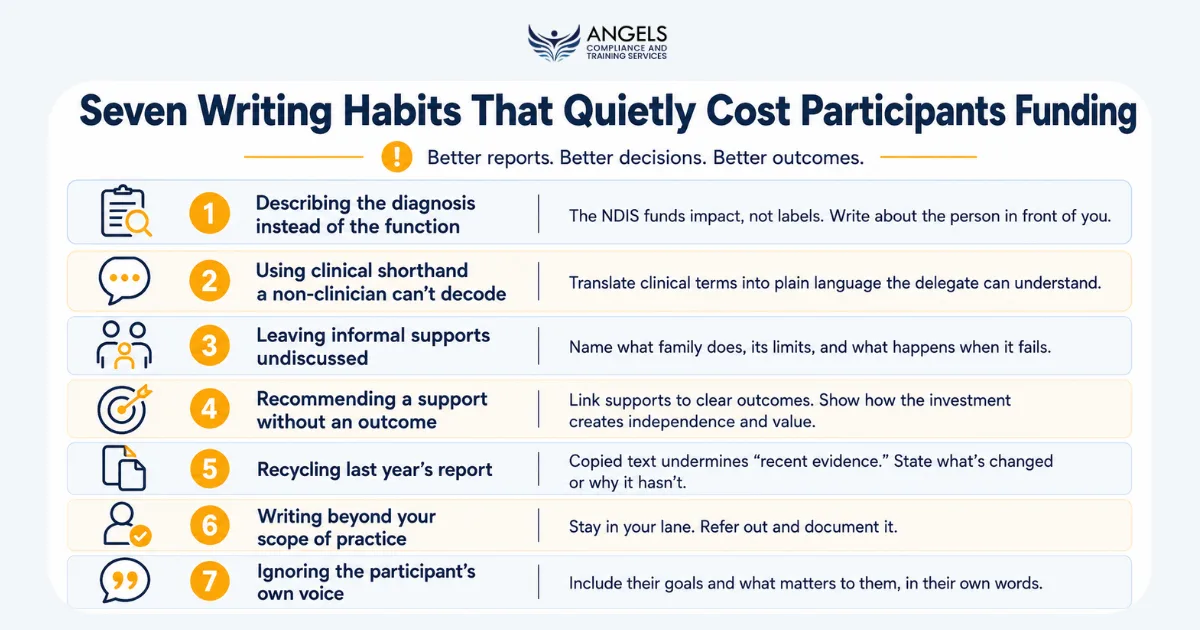
- Describing the diagnosis instead of the function.The NDIS funds impact, not labels. Two people with the same diagnosis can need entirely different supports. Write about the person in front of you.
- Using clinical shorthand a non-cliniciancan’tdecode. “Reduced praxis affecting ADL sequencing” means nothing to a delegate. “Cannot work out the order of steps to make a meal, so leaves the stove on” means everything. Keep the clinical term if you need it for professional accuracy, then translate it immediately.
- Leaving informal supports undiscussed. If youdon’t address what family already does, a delegate may assume family can simply do more. Name the informal support, name its limits, and name what happens when it fails. Carer capacity is a legitimate and often decisive part of the argument.
- Recommending a support without an outcome: “Recommend 40 hours of OT” invites a counter-offer. “Recommend 40 hours of OT across 12 months to establish an independent morning routine, reducing daily paid personal care from 90 to 30 minutes” invites approval, because it shows the investment paying for itself.
- Recycling last year’s report. Copied text is easy to spot, undermines the “recent evidence” requirement, and is a genuine record-keeping risk. If nothing has changed, say so explicitly and evidence how you know that is a finding in itself.
- Writing beyond your scope of practice. A physiotherapist recommending psychological therapy, or an OT opining on medication, weakens the whole document. Refer out and say you have.
- Ignoring the participant’s own voice. Include what the participant and their family said they want, in their words. Goals in the participant’s language are the thread that ties your recommendations to the statutory test.
A simple quality check before you send
Read the report as though you are a delegate with four minutes. Can you find, without hunting: the assessment dates, what the person cannot do, why it matters, what is recommended, how much it costs, and what it will change? If any of those takes more than a few seconds to locate, the problem is structural, not clinical.
Then ask the harder question: if this recommendation were reduced by half, does the report explain what the participant would lose? If not, expect it to be reduced.
Getting your team writing consistently
Individual clinicians improve slowly on their own. Teams improve quickly when they share a template, a worked example, and a peer-review step, usually a ten-minute check by a second clinician before anything leaves the building.
Angels Compliance and Training Services works with NDIS and DVA providers across Australia on exactly this kind of documentation discipline, alongside registration, renewal and audit preparation. If your reports are technically strong but your plan outcomes don’t reflect it, that gap is fixable, and it is usually fixable fast. Get in touch with our team to talk through where your documentation is losing ground.