
If you deliver Supported Independent Living (SIL) supports, a date has just become very important to your business: 1 July 2026. From that day, delivering SIL without being registered with the NDIS Quality and Safeguards Commission stops being an administrative grey area and becomes a serious offence.
If you’re reading this while juggling rosters, participant needs, and a dozen other priorities, and you’re not entirely sure whether this applies to you or where to even start you’re not alone. Most providers we speak with are in exactly that position. The good news is that this transition is completely navigable with the right preparation, and this article lays out precisely what’s changing, who it affects, the deadlines that matter, and how to get audit-ready in time.
At Angels Compliance and Training Services, we help SIL providers move from “where do we begin?” to being fully prepared without the overwhelm. Let’s walk through it.
What’s actually changing on 1 July 2026
In December 2025, the Minister for the NDIS confirmed that mandatory registration for Supported Independent Living and platform providers would commence from 1 July 2026. Put simply: every provider delivering NDIS-funded SIL supports must be registered with the NDIS Commission.
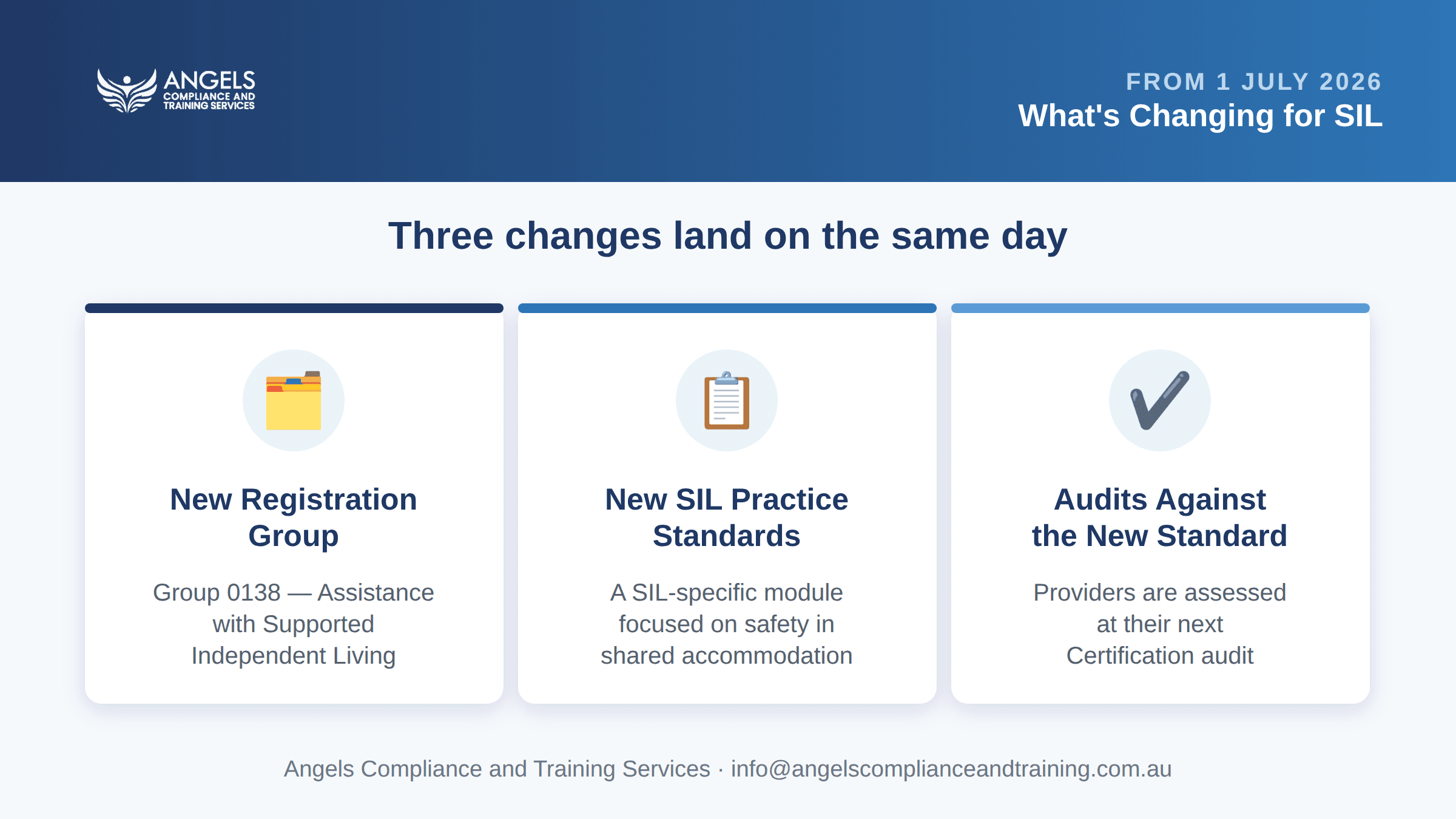
Three concrete changes land on that same day:
- A new registration group — 0138 Assistance with Supported Independent Living is created specifically for SIL supports.
- A new SIL module of the NDIS Practice Standards commences, sitting alongside the existing Core Module. This is a SIL-specific set of quality and safety benchmarks focused on shared accommodation and daily supports.
- Audits against the new standard begin — registered SIL providers will be assessed against the new module at their next audit.
Why is this happening? Briefly: the change responds to recommendations from the NDIS Review, the Disability Royal Commission, and the NDIS Commission’s own inquiries into supported accommodation, which found that the large majority of reportable incidents in the scheme occurred in group-home settings. The reform is designed to lift quality and safety where the risks to participants are highest.
That’s the context. But what matters most for you isn’t the backstory; it’s whether you’re in scope, and what to do about it.
What this means for you: SIL is moving from a lightly regulated space to one with formal registration, dedicated standards, and independent audits. If you deliver these supports, “doing nothing” is no longer an option.
Does this apply to me?
This is the first question to answer, because everything else flows from it.
The new requirements apply to providers delivering Supported Independent Living and to platform providers (online marketplaces connecting participants with support workers). Under the NDIS Commission’s definition, you’re likely delivering SIL if:
- You provide a package of home and living support to participants with higher support needs, and
- The participant requires support at all times of the day, or for most of the day, and
- Your assistance helps the participant live in their home as autonomously as possible including help with or supervision of daily tasks such as personal care, cooking, and cleaning, often in shared accommodation.
Ask yourself:
- Do I deliver home and living supports to participants who need support most or all of the day?
- Am I currently delivering these supports as an unregistered provider?
- Do I operate a platform connecting participants and workers?
If you answered yes to the first (or the third), this reform almost certainly applies to you. The precise scope is set out in the Commission’s formal definition and the updated Provider Registration Rules, which are the reference point for any borderline situation and exactly the kind of grey area we help providers work through.
Not sure whether you’re in scope? This is one of the most common questions we hear, and getting it right early saves a lot of stress later. Angels can confirm where you stand.
The deadlines that really matter
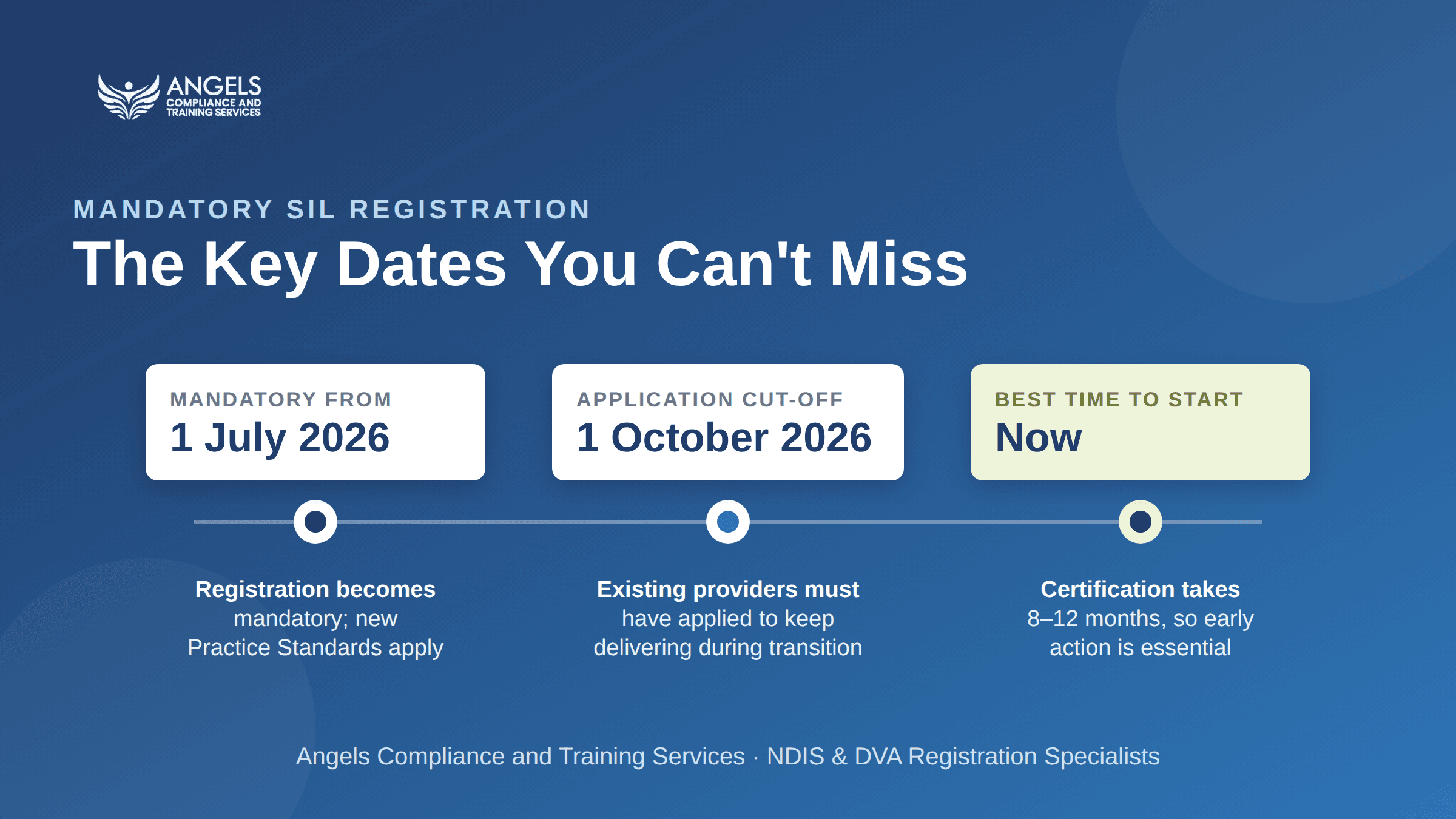
There isn’t just one date to know, there are three, and the gap between them is where many providers will get caught out.
- 1 July 2026 — Registration becomes mandatory. The new registration group and SIL Practice Standards module take effect.
- 1 October 2026 — The critical transition cut-off. Existing unregistered SIL providers who are already delivering support can continue operating during the transition only if they have applied for registration by this date. Miss it, and you’re not permitted to keep delivering SIL.
- Now — Realistically, the date you need to start. Here’s why.
The registration assessment for SIL is a Certification audit, and certification typically takes 8 to 12 months end-to-end. That means applying close to the October cut-off doesn’t leave enough runway to complete the process smoothly. The providers who will transition without drama are the ones who begin preparing months ahead, mapping their gaps, building their systems, and booking their audit while auditor availability still exists.
What this means for you: The headline is 1 July 2026, but your real planning deadline is much sooner. Treat the next few weeks as the window to get moving, not the months just before October.
What’s at stake if you’re not ready
Let’s be straight about this without overstating it.
Providing SIL on or after 1 July 2026 without being registered may breach the NDIS Act. The consequences are significant, both regulatory and operational:
- You can’t lawfully deliver SIL. A provider who misses the cut-off or starts SIL afterward without registration is not permitted to deliver those supports and may face compliance and enforcement action.
- Participants are disrupted. People who rely on your support could face interruption to their care, the outcome no provider wants.
- Business continuity and reputation take a hit. Pausing a core service line, or scrambling at the last minute, carries real financial and reputational cost.
None of this is cause for panic. It is cause for action. Every one of these risks is avoidable with timely, well-organised preparation, which is exactly what the rest of this article (and our team) is here to help with.
How to prepare: your SIL readiness roadmap
Here’s the practical part. Breaking the transition into clear stages turns a daunting requirement into a manageable plan:
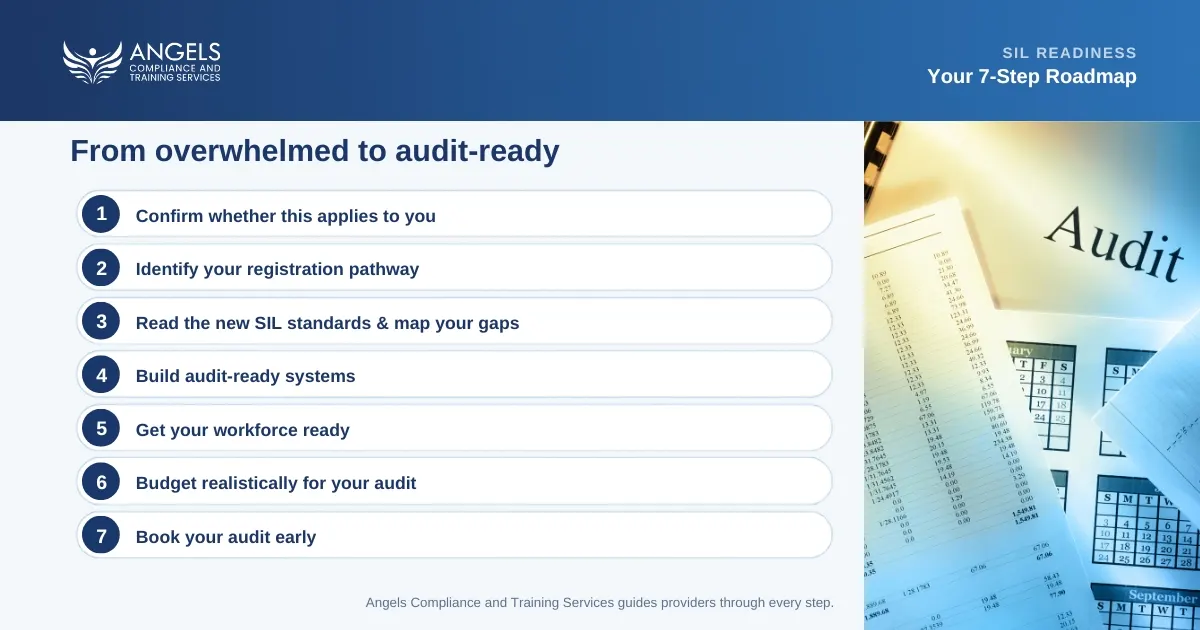
- Confirm scope. Verify whether the new SIL definition applies to your services. Don’t assume, check against the Commission’s definition.
- Identify your pathway. Your transition route depends on your current registration status. A brand-new provider, an existing registered provider adding SIL, and an unregistered provider already delivering SIL each follow different pathways.
- Read the new SIL module and map the gaps. Compare the new standards against how you actually operate today. Identify where your governance, policies, worker training, and day-to-day practice fall short now, not in July.
- Build audit-ready systems. Strengthen or create the policies, procedures, risk management, and evidence that the standards require. The aim is sustainable compliance you can maintain not a one-off paperwork exercise.
- Get your workforce ready. Much of the new SIL standard targets frontline support quality, worker training, and competence. Brief your teams early and address any training gaps.
- Budget realistically for your audit. Certification audits aren’t cheap, and the cost scales with the number of participants, staff, and sites. A small single-site SIL provider should plan for a meaningful audit investment, and larger providers should build it into their planning.
- Book your audit early. With many providers entering the system at once and a finite number of approved quality auditors, audit slots are in demand. Booking early protects your timeline.
Working through seven stages while running a service is a lot, which is where having an experienced partner makes the difference between a stressful scramble and a smooth, confident transition.
How Angels Compliance and Training Services can help
This is what we do every day. We take providers through each step of that roadmap and do the heavy lifting so you can keep focusing on participants:
- Scope and pathway confirmation — we tell you clearly whether you’re in scope and which transition pathway applies.
- Gap analysis — we map the new SIL standards against your current operations and give you a prioritised, plain-English list of what needs to change.
- Audit-ready systems — we build the policies, procedures, and evidence frameworks the standards require, designed to be maintained, not just passed once.
- Worker screening and training — we help get your workforce compliant and confident against the new expectations.
- End-to-end support through your audit — from preparation to the audit itself, you have an experienced team beside you.
What sets us apart is simple: we’re practitioners, not just paperwork. Our programmes are built by people who understand compliance and the realities of running a service from the inside. We don’t hand you a folder of templates and wish you luck; we build sustainable systems and stay with you through the deadline. Calm, clear, and responsive when you need it most.
You don’t have to navigate this alone
Let’s bring it back to the essentials. 1 July 2026 is when SIL registration becomes mandatory. 1 October 2026 is the cut-off to have your application in if you’re already delivering. And because certification takes the better part of a year, the time to act is now.
The deadline is firm, but with early, organised preparation, this transition is entirely manageable. Thousands of providers are working through it, and the ones who start early will be the ones who get there calmly and on time.
That’s where we come in. If you’d like clarity on where you stand and a clear plan to get registered and audit-ready, the team at Angels Compliance and Training Services is here to help.
Book a free consultation today, and let’s make sure your service is ready well before the deadline.
Frequently asked questions
1. When exactly does SIL registration become mandatory?
From 1 July 2026. On that date, SIL and platform providers must be registered with the NDIS Commission, and the new registration group and SIL Practice Standards module take effect.
2. What happens if I don’t register by 1 October 2026?
Existing unregistered SIL providers can only continue delivering during the transition if they’ve applied for registration by 1 October 2026. If you haven’t applied by then or you start SIL after the cut-off without registration, you’re not permitted to deliver SIL supports and may face enforcement action.
3. How long does SIL registration and certification take?
The SIL registration assessment is a Certification audit, which typically takes 8 to 12 months from start to finish. Because of this timeframe, it’s important to begin the process well ahead of the deadlines rather than close to them.
4. How much does a SIL Certification audit cost?
Costs vary based on the size of your operation, the number of participants, staff, and sites, all of which affect audit duration and price under the legislated sampling method. Smaller single-site providers should budget a meaningful minimum, with larger or multi-site providers paying more. We can help you estimate your likely audit scope.
5. I’m a brand-new SIL provider. Where do I start?
Start by confirming you’re in scope, then identify the registration pathway for new providers. From there, it’s about building compliant systems and preparing for your Certification audit. This is exactly the journey we guide new providers through. Get in touch, and we’ll map it out with you.
6. What are the new SIL Practice Standards?
They’re a SIL-specific module of the NDIS Practice Standards, focused on quality and safety in shared accommodation and daily supports, with a strong emphasis on participant-centred outcomes, human rights, privacy, worker training, and safety in shared living settings. They were co-designed with people with disability.
This article reflects information available as of June 2026. The NDIS Commission was still finalising aspects of the SIL registration requirements, Practice Standards, and transition arrangements at the time of writing. For the most current and authoritative detail, refer to the NDIS Quality and Safeguards Commission’s mandatory registration page, and speak with us about your specific circumstances.