

Supported Independent Living sits at the heart of many participants’ lives. It covers the help people receive every day in their own home, often shared with other residents. That is exactly why the regulator now expects every provider in this space to be registered and independently audited.
For many organisations, this is the first time their day-to-day practice will be measured against the NDIS Practice Standards by an external auditor. Some have delivered excellent support for years without formal documentation. Others hold generic templates that were never adapted to how their houses actually run.
This guide walks through what has changed, what auditors look for, the gaps we most often see, and how to prepare your people and paperwork. It draws on our work supporting providers through registration, renewal and audit preparation across Australia.
What Has Changed for Supported Living Providers
From 1 July, SIL registration with the NDIS Quality and Safeguards Commission became mandatory for every organisation delivering NDIS-funded Supported Independent Living. Size, structure and participant numbers make no difference. A sole operator supporting two residents faces the same core expectation as a large provider running dozens of houses.
Registration for this support type requires a certification audit, the more rigorous of the two NDIS audit types. It is carried out by an NDIS Commission-approved quality auditor and generally runs in two stages:
1. Stage one – documentation review. The auditor examines your governance documents, sil policies and procedures, risk registers and records to confirm your systems exist on paper and match the Practice Standards.
2. Stage two – on-site assessment. The auditor visits your service, interviews staff and, with consent, participants. They check that what is written is actually happening in the houses.
The second stage is where many providers come unstuck. A well-written policy that staff have never seen, or that describes a process nobody follows, is treated as a gap. Auditors are trained to test the link between documents and daily practice.
If you are still working through the application itself, our guide to NDIS registration explains the earlier steps in more detail.
The Policy Areas an Auditor Will Expect to See
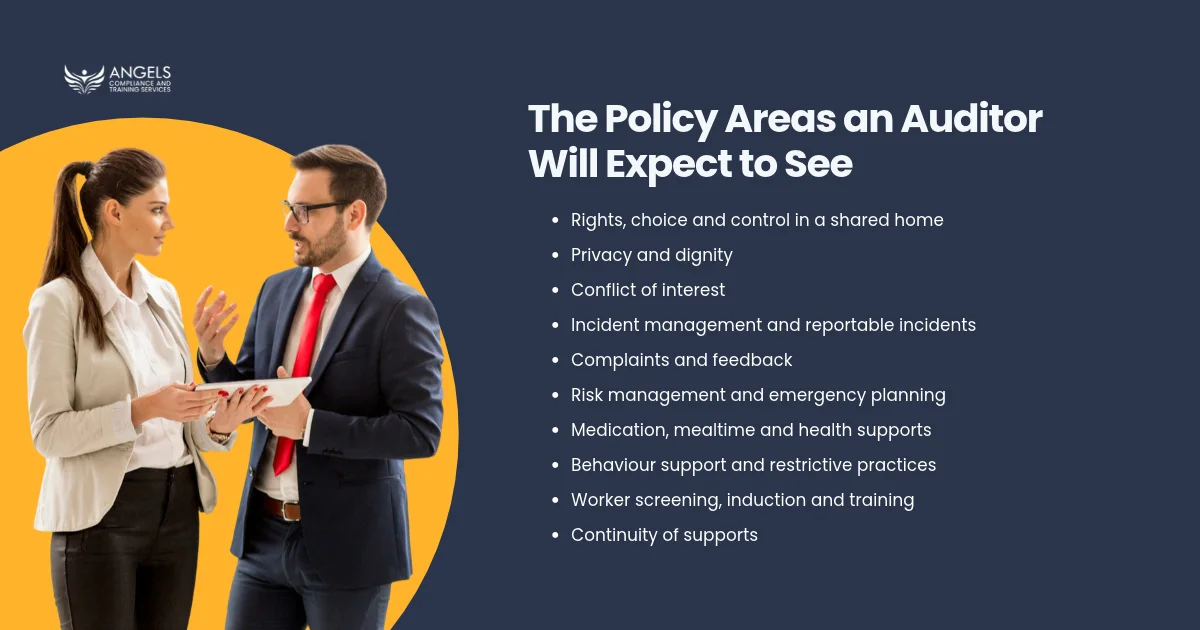
The NDIS SIL requirements sit across the Core Module of the Practice Standards, plus any supplementary modules that apply to your participants. In a shared home, each area needs to reflect how support is actually delivered behind the front door. These are the areas auditors focus on most closely.
1. Rights, choice and control in a shared home. Residents share kitchens, routines and sometimes support workers. Your policies should show how each person’s preferences are respected, how house decisions are made together, and how individual choice is protected when it conflicts with the group.
2. Privacy and dignity. Support happens in bedrooms and bathrooms, and records are often kept on site. Auditors look for clear rules on personal information, intimate care, visitors, and how staff enter private spaces.
3. Conflict of interest. Many providers deliver SIL and also hold a link to the housing, through Specialist Disability Accommodation or a tenancy arrangement. You need a documented approach that separates housing from support, so participants can change provider without losing their home.
4. Incident management and reportable incidents. Every serious incident must be identified, managed, recorded and, where required, reported to the Commission within set timeframes. Your NDIS incident management process should name who does what, and staff should know it without reaching for a folder.
5. Complaints and feedback. Residents and families need an easy, safe way to raise concerns. Auditors check that complaints are logged, acted on, and used to improve the service.
6. Risk management and emergency planning. Shared living brings specific risks such as fire, evacuation, medical emergencies and conflict between residents. Expect questions about individual risk assessments and house-level emergency and disaster plans.
7. Medication, mealtime and health supports. Where workers assist with medication, swallowing difficulties or complex health needs, auditors expect documented procedures, training records and clear escalation steps.
8. Behaviour support and restrictive practices. If any resident has a behaviour support plan, your practices must match it exactly. Unauthorised restrictive practices are a major audit concern. Our guide to behaviour support and restrictive practices covers the obligations in detail.
9. Worker screening, induction and training. Auditors sample staff files for NDIS worker screening clearances, qualifications and induction records. Strong support worker induction and orientation is one of the easiest ways to show compliance in practice.
10. Continuity of supports. Rosters change, and staff leave. Your procedures should explain how support continues through absences, illness, and emergencies without disrupting residents.
Each of these areas links to evidence the auditor will request. A policy is the starting point, but it must be backed by records showing it works.
Why Generic Templates Rarely Survive a SIL Audit
Generic NDIS policies and procedures are written for any service type, from therapy to transport. They tend to describe processes in broad terms and leave out what makes shared living different: rosters across multiple houses, overnight support, shared tenancy arrangements and the dynamics between residents.
Auditors notice quickly when documents do not match the service in front of them. Common signs include references to services you do not deliver, job titles that do not exist in your organisation, and processes that assume a clinic rather than a home. Each mismatch raises doubts about whether staff actually follow the policy.
Tailored sil policies and procedures solve this by starting from your real operations. They name your roles, describe your house routines, and reflect the participants you support. When staff read them, they recognise their own work, which makes training easier and interviews more confident.
This is the thinking behind our SIL Tailored Policy & Procedure + Compliance Package. For a fixed $650, it includes SIL policies and procedures written specifically for your organisation, delivered within 48 hours. It also comes with a free SIL training and pre-audit coaching session, plus practical guidance on the SIL requirements so you understand what the auditor will ask and why.
The NDIS SIL guidelines published by the NDIA and the Commission also change from time to time. Documents built around your service are far easier to update than a stack of templates you never fully adapted.
Common Gaps That Delay Supported Living Audits
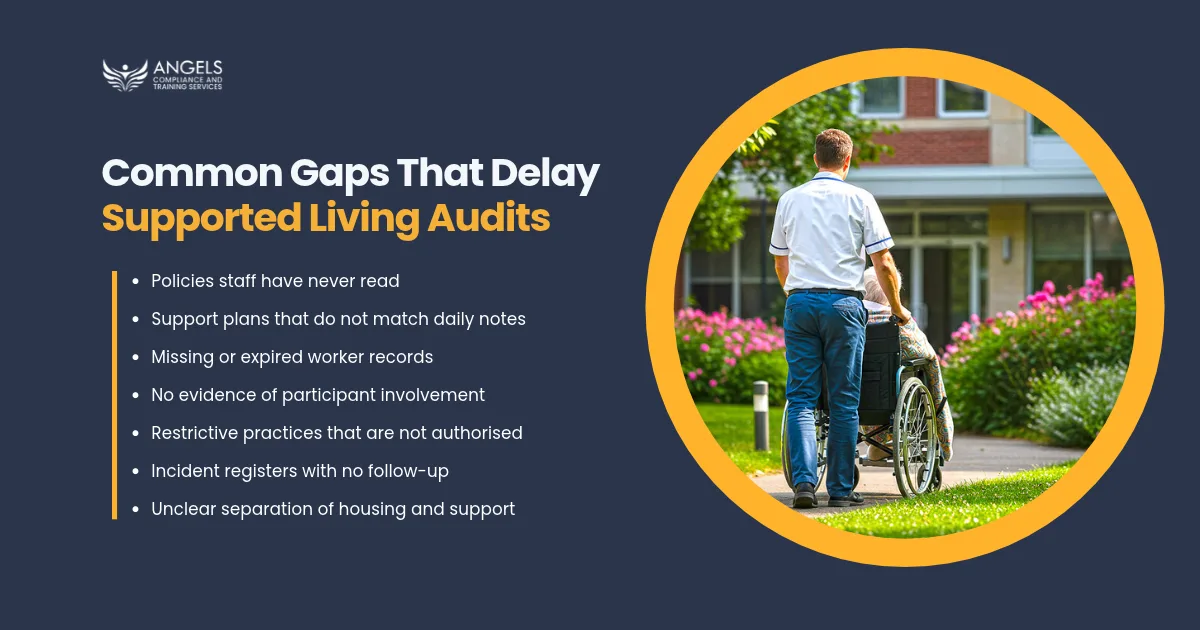
Most audit findings are not caused by poor care. They come from gaps between good intentions and the evidence an auditor needs to see. These are the issues we see most often when helping providers prepare.
- Policies staff have never read. Documents sit in a shared drive, but workers cannot explain the incident or complaints process when asked. Build policy reading into induction and team meetings, and keep signed acknowledgements.
- Support plans that do not match daily notes. A participant’s plan says one thing and the shift notes describe another. Auditors compare the two, so plans need regular review as needs change.
- Missing or expired worker records. One expired screening clearance, or missing first aid certificate in a sampled file becomes a finding. Keep a training and clearance register with expiry dates and reminders.
- No evidence of participant involvement. House rules, menus and routines decided without residents suggest choice and control are not being upheld. Record house meetings and individual conversations.
- Restrictive practices that are not authorised. Locked cupboards, restricted access to items, or routine PRN use may count as restrictive practices. If they are not in an authorised behaviour support plan, they are a serious concern.
- Incident registers with no follow-up. Logging an incident is only half the job. Auditors look for investigation, actions taken, and changes made to prevent a repeat.
- Unclear separation of housing and support. Where one organisation influences both, the participant’s right to change SIL provider must be documented and protected.
If several of these sound familiar, a structured NDIS Practice Standards self-assessment is a practical first step. It shows where your gaps sit before an auditor finds them.
Preparing Your People and Evidence Before Audit Day
Documents get you through the first stage. Your team gets you through the second. The on-site visit tests whether the people delivering support understand the systems behind it.
Start with a walk-through of each house as an auditor would see it. Check that emergency plans are displayed, records are stored securely and any restrictive practices match authorised plans. Small things, such as an unlocked filing cabinet with participant files, can shape the auditor’s first impression.
Next, prepare your staff for interviews. Auditors usually ask open questions, such as what workers would do if a resident was injured or wanted to make a complaint. Run short practice conversations in team meetings so answers come naturally, not from memory of a document.
Then organise your evidence so it can be found quickly. Group records by Practice Standard, such as incident registers, complaints logs, training registers, support plans with review dates, and minutes from house meetings. A tidy evidence pack shortens the audit and reduces follow-up requests.
Finally, involve participants in the right way. With their consent, residents may speak with the auditor. Explain the process in plain language, make clear that taking part is their choice, and offer support if they want someone with them.
If this will be your first audit, our NDIS audit and compliance support service can guide you through each stage, from document review to the auditor’s final report.
How Angels Compliance Can Help
Angels Compliance and Training Services works with NDIS and DVA providers on registration, renewal, audits and staff training. We understand that most SIL providers are small teams balancing rosters, residents and compliance at the same time.
Our SIL package is built for that reality. You receive tailored policies and procedures within 48 hours, a free pre-audit coaching session and practical guidance on what the auditor will test, all for a fixed $650. No open-ended quotes and no generic templates.
View the SIL Tailored Policy & Procedure + Compliance Package or call 1800 241 164 to talk through your service.
Frequently Asked Questions
1. Do all SIL providers need to be registered?
Yes. Registration is now mandatory for every organisation delivering NDIS-funded Supported Independent Living, regardless of size or structure.
2. What type of audit applies to SIL?
A certification audit, completed by an NDIS Commission-approved quality auditor. It includes a documentation review and an on-site assessment.
3. Can I use the same policies for SIL and my other services?
Core policies may overlap, but SIL needs documents that reflect shared living, rosters across houses, housing and support separation, and resident rights in a group setting.
4. How long does it take to get audit-ready?
It depends on your starting point. Providers with tailored documents and trained staff can prepare far faster than those starting from generic templates.
5. What if I already have policies but am not sure they are good enough?
A self-assessment or a pre-audit coaching session will show which documents need updating before the auditor arrives.