

Working in the NDIS sector is a responsibility that goes far beyond providing day-to-day support. Whether you are a frontline support worker, a sole trader, or a registered provider, participants and their families place enormous trust in you. They rely on you for safety, dignity, consistency, and quality care. Because of this, workforce compliance is not just paperwork it’s the foundation of safe and ethical NDIS service delivery.
Two key elements help maintain this standard across Australia:
1. The NDIS Worker Check (NDISWC)
This national screening ensures that anyone in a risk-assessed role is suitable to work with people with disability. It assesses criminal history, past misconduct, and other relevant risks, offering strong protection for participants and peace of mind for providers.
2. Mandatory Training Requirements
Every NDIS worker must be trained to understand the Code of Conduct, uphold participant rights, manage incidents safely, and deliver quality support. This includes the Worker Orientation Module and organisation-specific induction.
Together, these requirements create a safer, more consistent, and more accountable workforce. They reduce risk, protect participants, and help organisations maintain the quality expected under the NDIS Practice Standards.
This guide breaks down what every worker and provider needs to know clearly, practically, and confidently.
Who Needs an NDIS Worker Check?
Understanding who requires an NDIS Worker Check (NDISWC) is essential for every provider, sole trader, and worker in the disability sector. The screening requirement applies to anyone in a risk-assessed role, meaning anyone who is likely to have direct, frequent, or influential involvement with NDIS participants. Below is a breakdown of the key groups who must hold a valid clearance.
1. Workers Delivering Support
Anyone providing direct NDIS-funded support must have a valid NDIS Worker Check. This includes workers who assist participants with daily living, personal care, or community participation.
Roles that must hold a clearance include:
- Support workers
- Community access/outreach workers
- Behaviour support practitioners
- Allied health assistants
- Mentors or coaches involved in capacity-building tasks
These workers interact closely with participants, often in private settings, which makes screening essential for safety and trust.
2. Workers With More Than Incidental Participant Contact
Some workers may not deliver support directly but still have frequent contact with participants as part of their role. These team members also require an NDIS clearance.
Examples include:
- Transport/NDIS community drivers
- Rostering and intake coordinators
- Reception or admin staff in support environments
- Case management or scheduling roles
- Community program staff
If a worker is in a position where they could build a relationship or influence participant safety, they must be screened.
3. Key Personnel and Decision-Makers
The NDIS Act also requires screening for “key personnel” individuals who hold significant responsibility within an organisation. This includes:
- Directors
- Board members
- Senior managers
- Responsible Persons and Executives.
These leaders shape organisation-wide policies, culture, and risk decisions. Their clearance ensures integrity at the highest level.
4. National Recognition
Once granted, an NDIS Worker Check is valid for five years across all states and territories. Workers can move roles, change states, or work with multiple providers without needing multiple screenings, making it practical, portable, and nationally trusted.
Provider vs Worker Responsibilities (Who Must Do What?)
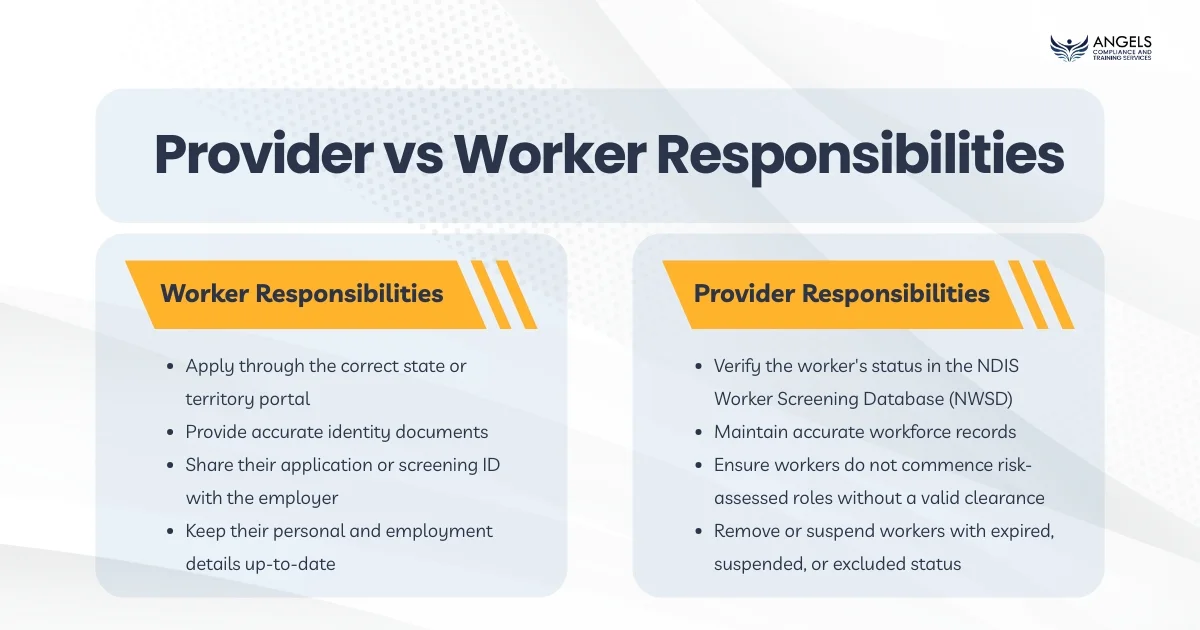
Compliance with the NDIS Worker Check (NDISWC) is a shared responsibility. Both the worker and the provider must follow specific steps to ensure only cleared, suitable individuals are supporting participants. Understanding these responsibilities helps prevent compliance gaps, audit risks, and most importantly safeguards participant wellbeing.
Worker Responsibilities
Workers play an active role in managing their own NDIS clearance. They must:
1. Apply through the correct state or territory portal
Workers submit their application online via Service NSW, Service Victoria, Blue Card Services QLD, and other state agencies. The application cannot be completed without listing an employer or participant (for self-managed NDIS participants).
2. Provide accurate identity documents
Workers must upload identification that meets the multi-document ID rules. Any mismatch in names must be supported with official change-of-name evidence.
3. Share their application or screening ID with the employer
This allows the provider to link the worker in the NDIS Worker Screening Database (NWSD) and begin monitoring their status.
4. Keep their personal and employment details up-to-date
If a worker changes address, employer, or legal name, they must update these details promptly. Failure to do so may cause delays or compliance complications.
Provider Responsibilities
Registered NDIS providers (and unregistered providers with risk-assessed roles) have legally enforceable responsibilities under the NDIS Practice Standards.
1. Verify the worker’s status in the NDIS Worker Screening Database (NWSD)
A worker is not considered cleared until the provider verifies them in the NWSD. Providers cannot rely on emails, PDFs, or screenshots from workers.
2. Maintain accurate workforce records
This includes clearance status, expiry dates, and evidence of role classification. Records must be audit-ready at all times.
3. Ensure workers do not commence risk-assessed roles without a valid clearance
No clearance = no work. Allowing a worker to start early is a major compliance breach.
4. Remove or suspend workers with expired, suspended, or excluded status
Providers must act immediately if a worker’s status changes.
How to Apply for the NDIS Worker Check

Applying for the NDIS Worker Check (NDISWC) is a straightforward process, but it must be done correctly to avoid delays, rejections, or compliance issues. Below is a step-by-step guide to help workers, sole traders, and providers understand exactly how the application process works.
Step 1: Prepare Identification Documents
Before starting the application, workers must gather the correct identification documents. The NDISWC uses a strict multi-document ID verification process, similar to banking and government identity checks. All documents must match especially names and any variations must be supported by official linking documents.
Accepted documents include:
- Australian birth certificate or passport
- Driver’s licence or photo ID card
- Medicare card
- Change-of-name evidence (marriage certificate, deed poll, etc.)
Workers must also list their employer’s NDIS Employer ID, which links the worker to the organisation and allows the provider to verify the application.
Step 2: Apply Through Your State or Territory Portal
Each Australian state and territory manages its own NDIS Worker Check portal. Applications must be submitted through these official platforms:
- NSW: Service NSW
- VIC: Service Victoria
- QLD: Department of Communities (Blue/Yellow Card Services)
- WA: DoTDirect
- SA: DHS Screening Unit
- TAS, ACT, NT: Respective government screening units
The general process includes:
- Completing the online application form
- Uploading identification documents
- Digital or in-person identity verification
- Paying the application fee
Fees vary depending on the state and whether the worker is paid, a volunteer, or a student.
Step 3: Wait, Monitor, and Stay Updated
Processing times for the NDISWC can vary widely from several days to a few weeks depending on the level of background checking required.
Once a decision is made:
- Workers receive confirmation of their clearance or exclusion
- Providers receive updates through the NDIS Worker Screening Database (NWSD)
Workers must keep their contact information updated, and providers must continuously monitor worker status to ensure ongoing compliance.
Mandatory NDIS Training Requirements
Mandatory NDIS training helps workers understand how to support participants safely, respectfully, and professionally. The first requirement for every worker is the NDIS Worker Orientation Module: “Quality, Safety and You.”
This short online course (around 90 minutes) covers:
- Human rights
- Respect and dignity
- Safety responsibilities
- The NDIS Code of Conduct
Once completed, workers receive a certificate that must be saved for audits or compliance checks. This module gives all NDIS workers a strong, consistent foundation helping them understand their responsibilities from the very beginning.
Provider-Specific Induction Training (Non-Negotiable Requirement)
Every registered NDIS provider must give workers a complete induction before they begin supporting participants. This induction must cover:
- Policies and procedures
- Privacy and confidentiality
- Incident management
- Work Health & Safety (WHS)
- Infection prevention and PPE
- Risk management
- Reportable incident processes
- Documentation and record-keeping standards
All induction must be documented, signed off, and stored for audits.
Using the NDIS Code of Conduct as the Backbone
Induction and ongoing training must reflect the Code’s core principles:
- Upholding participant rights
- Acting with integrity
- Preventing harm
- Supporting choice and dignity of risk
Training should embed ethical, participant-centred practice, not just rule compliance.
How Angels Compliance & Training Helps Providers Stay Compliant
Navigating NDIS compliance can feel overwhelming especially for growing providers managing multiple workers, services, and documentation requirements. At Angels Compliance & Training, we make this process simpler, clearer, and fully aligned with the NDIS Practice Standards. Our role is not just to advise but to walk alongside providers, helping them build strong, confident, audit-ready teams.
We specialise in supporting organisations across Australia with end-to-end compliance services, including:
✔ Worker Screening and NDISWC Processes
We help providers set up reliable systems for verifying NDIS Worker Check clearances, maintaining up-to-date records, and ensuring only approved workers perform risk-assessed roles.
✔ Mandatory and Advanced Staff Training
From the Worker Orientation Module to high-intensity support training, we ensure your team is well-trained, confident, and meeting all competency requirements.
✔ Induction Program Design
We create tailored induction programs covering WHS, privacy, incident management, restrictive practices, documentation standards, and Code of Conduct expectations.
✔ Policy and Procedure Development
We design clear, audit-ready policies that reflect your organisation’s services while meeting the NDIS Practice Standards and Quality Indicators.
✔ Audit Preparation and Coaching
Whether you’re preparing for verification, certification, or mid-term audits, we guide you step-by-step through evidence collection, documentation setup, and quality improvements.
✔ Risk Management and Continuous Improvement Systems
We assist with incident systems, risk registers, feedback processes, and quality improvement frameworks, everything you need to stay compliant long-term.
At Angels Compliance & Training, we don’t believe in box-ticking. We help you embed compliance into daily practice, so your organisation operates smoothly, safely, and confidently and your team is always ready for audits, investigations, or growth.
Conclusion: Compliance Isn’t a Task, It’s a Commitment
NDIS compliance goes far beyond meeting rules or passing audits. The NDIS Worker Check and mandatory training exist to protect participants and ensure every worker is safe, prepared, and committed to providing quality support. When providers invest in strong screening, proper induction, and ongoing training, they create a workforce that is skilled, trustworthy, and confident.
Compliance is ultimately about people, their rights, their safety, and their well-being. By treating compliance as an ongoing commitment rather than a checklist, providers help build a safer, stronger, and more ethical disability support sector for all Australians.