

If you run an NDIS‑registered service in WA, staying on top of pricing rules isn’t optional — it’s essential. The updated 2025‑26 version of the National Disability Insurance Agency (NDIA) pricing guidelines, now called the NDIS Pricing Arrangements and Price Limits (PAPL), sets the maximum allowable rates and billing rules for support.
As a specialist in compliance, audit, and training, Angels Compliance and Training Services supports NDIS providers to navigate these changes smoothly and remain compliant with NDIS regulations.
In this blog, we break down what the 2025‑26 “NDIS Price Guide 2026” means for providers, and highlight how you can prepare and stay ready for audits.
What is the NDIS Price Guide / Pricing Arrangements & Price Limits (PAPL)?
1. Evolution of the Price Guide
What has historically been known as the “NDIS Price Guide” is now formally referred to as “Pricing Arrangements and Price Limits (PAPL).”
Each year, the NDIA reviews and releases updates to this guide, to reflect current costs, wage changes, market conditions, and feedback from stakeholders.
2. What PAPL Covers
- A Support Catalogue listing all support items (therapies, disability support work, core supports, capital supports, capacity‑building supports, etc.) associated with unique line item codes.
- Price limits for each support item, i.e. the maximum a registered provider can charge for that support.
- Claiming rules, including when providers can claim for travel, non-face‑to‑face supports, group supports, or supports delivered in remote or very remote locations — depending on item and context.
Importantly: the guide sets maximum allowable prices, not fixed prices. Providers may charge at or below the limit; they must never exceed it.
What’s New in the 2025–26 / 2026 NDIS Price Guide
1. Official Release & Update Schedule
- The 2025–26 PAPL was officially released on 14 October 2025, with the changes taking effect from 24 November 2025.
- Since then, periodic updates and addenda may be issued to reflect changes, providers should monitor the NDIA website for any further revisions.
2. Key Changes & Pricing Adjustments
- The guidance and structure remain consistent: all supports must use the correct line item codes from the Support Catalogue.
- Price limits for many supports have been updated to reflect recent changes in service costs, wage rates, and operational costs, meaning providers need to re-check their billing rates against the new limits.
- The PAPL clarifies billing rules around travel, non-face-to-face support, group support, and location-based pricing.
These updates mean that billing practices, even those that were compliant under the last guide, may now need revisions to remain compliant.
What These Changes Mean for Providers – Compliance & Operational Impact
When the new NDIS pricing guide is applied, providers face both opportunities and risks. Proper management is critical.
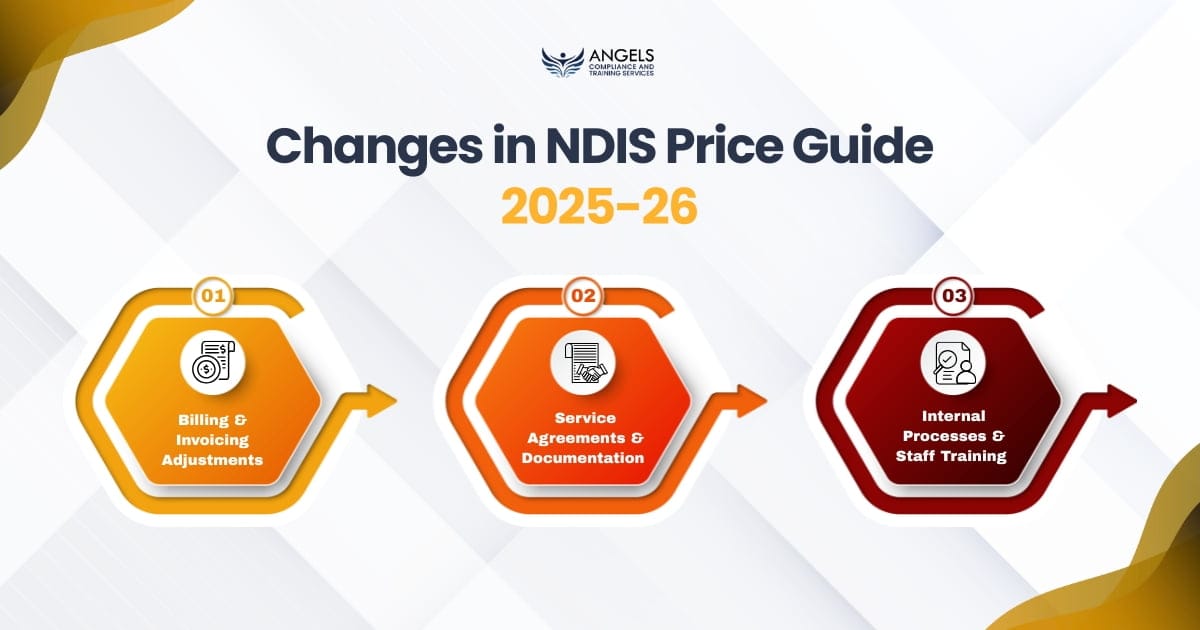
1. Billing & Invoicing Adjustments
- Providers must update their billing or practice-management systems to reflect the new rate limits, using the correct support item codes.
- Overcharging beyond the published price limits or using outdated line-item codes can lead to claim rejections, audit findings, or compliance breaches.
- For plan-managed and agency-managed participants, staying within the official price limits is mandatory.
2. Service Agreements & Documentation
- All service agreements and participant contracts need to be reviewed and, if necessary, updated to reflect the new rates and billing rules.
- Documentation of support delivery (dates, item codes, support type, travel or non-face-to-face billing) must align with PAPL requirements to ensure audit readiness.
3. Internal Processes & Staff Training
- Admin, billing, therapy, and support staff must be briefed and trained on the new guides, codes, and compliance requirements.
- Providers should conduct internal audits to review past invoices and confirm compliance, especially during the transition phase.
How NDIS Providers in WA Can Prepare – with Support from Angels Compliance & Training Services
The changes introduced by the new NDIS Price Guide can be complex. For many providers, especially small or mid‑size organisations, ensuring full compliance requires careful planning, system updates, and staff training. That’s where Angels Compliance and Training Services can help.
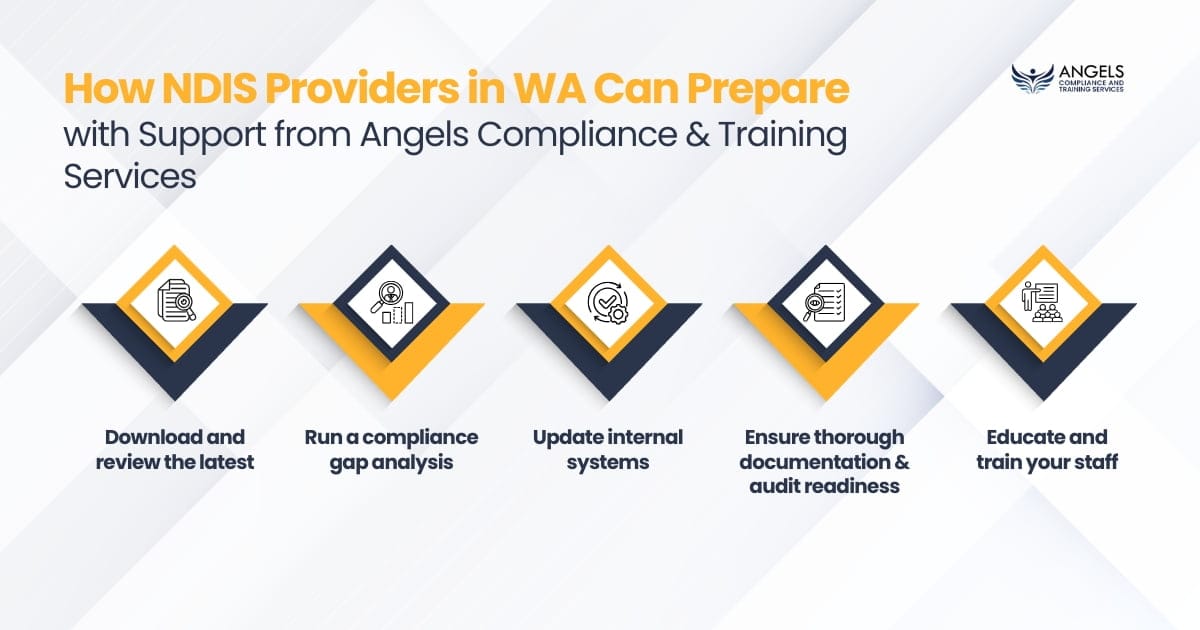
Here’s how you can prepare, and how we can support you:
- Download and review the latest PAPL 2025‑26 and Support Catalogue to identify relevant supports and price limits.
- Run a compliance gap analysis: compare your existing billing practices, pricing structure, and service agreements with the new guide to uncover any non‑compliant areas or risk zones.
- Update internal systems: billing, payroll, service agreements, client records, all align with the latest pricing and claiming rules.
- Ensure thorough documentation & audit readiness: set up protocols to document each support session correctly, especially if they involve travel, group support, or non-face-to-face time.
- Educate and train your staff: admin, support workers, therapists, everyone must understand the changes, how to code services, and what compliance looks like.
If you’d like expert help to navigate this transition, contact Angels Compliance and Training Services. We specialise in compliance assessments, mock audits, training sessions, and documentation audits tailored for NDIS providers in WA.
Risks of Non‑Compliance & Common Pitfalls to Avoid
Failing to align with the updated NDIS Price Guide can result in serious consequences:
- Claim rejections or delayed payments — incorrect line items or overcharging may lead to invoices being rejected or underpaid.
- Audit findings or compliance breaches — during an audit, documentation or billing inconsistencies may trigger compliance issues, impacting your provider status.
- Client dissatisfaction or disputes — if service agreements aren’t updated, participants may be unaware of changes in rates or billing practices, leading to confusion or mistrust.
- Operational disruption — last-minute changes, rushed corrections, or mass re‑billing can disrupt workflows and staff morale.
Practical Checklist for Providers – What to Do After Reading This Guide
- Download the latest PAPL 2025‑26 and Support Catalogue from the NDIA website
- Review all support items you deliver and check applicable price limits
- Update billing/practice‑management software with new rates and correct line item codes
- Revise all service agreements with participants to reflect rate changes and billing rules
- Inform clients about changes in service pricing or billing practices (travel charges, non-face‑to‑face supports, group sessions)
- Conduct internal audit & compliance review of invoices and documentation from the past 6–12 months
- Provide team training on new coding, billing, documentation and compliance requirements
- Establish ongoing documentation and record‑keeping procedures for audit readiness
Conclusion
The 2025–26 update to the NDIS “Price Guide” now the Pricing Arrangements and Price Limits, represents more than just a change in numbers. It affects how providers bill, document, and deliver support. For NDIS providers in WA, understanding and implementing these changes correctly is vital to remain compliant, audit-ready, and financially sustainable.
If you want to ensure your organisation meets all compliance requirements under the new guide, from billing and documentation to audits and staff training, Angels Compliance and Training Services is here to help.
Contact us today for a full compliance audit, mock audit report, team training, or support with updating your pricing, documentation and service agreements.
Stay compliant, stay confident, and keep delivering high‑quality NDIS services with peace of mind.
Frequently Asked Questions (FAQs)
Q1: What’s the difference between the NDIS Price Guide and Pricing Arrangements and Price Limits (PAPL)?
The term “NDIS Price Guide” is an older term. The official name now used by the NDIA is “Pricing Arrangements and Price Limits” (PAPL), which includes both price limits and service conditions.
Q2: When did the 2025–26 PAPL come into effect?
The 2025–26 version of the Pricing Arrangements and Price Limits came into effect on 1 July 2025.
Q3: Can I still use old pricing or line item codes from previous years?
No. All billing and service documentation must align with the most current version of the PAPL. Using outdated codes or price limits may result in rejected claims.
Q4: Can providers charge more than the stated price limits?
No. Registered providers must not charge above the published price limit for supports in the PAPL. This ensures fairness and transparency across all participant plans.
Q5: What’s the best way to ensure I’m compliant with the 2026 pricing guide?
Use the checklist provided in this blog and reach out to a compliance expert like Angels Compliance and Training Services for a mock audit or tailored compliance training.