

Most NDIS providers do not set out to break the rules. Many genuinely believe they are compliant. Policies exist, staff have completed training, and previous audits may have been passed. Yet year after year, investigations reveal the same issue: NDIS Code of Conduct breaches that were unintentional but entirely preventable.
The uncomfortable reality is that many breaches happen quietly. They emerge through everyday interactions, informal conversations, documentation shortcuts, weak supervision, and cultural blind spots. A boundary that slowly shifts, an incident dismissed as “too minor” to report, or a staff member working outside their scope without challenge can all become serious compliance risks. These behaviours rarely look like misconduct at first, which is why they are often overlooked.
This article explores the NDIS Code of Conduct risks nobody talks about. It explains how breaches occur in real practice and what providers must do to protect participants, support staff, and safeguard their organisation.
What Is the NDIS Code of Conduct — and Why It Matters
The NDIS Code of Conduct sets the minimum standards of behaviour expected of anyone delivering NDIS supports. It applies to all workers, including employees, contractors, volunteers, and key personnel, regardless of whether a provider is registered or unregistered.
If you’re asking what is NDIS Code of Conduct, the answer is simple: it exists to protect participants from harm and ensure supports are delivered safely, respectfully, and ethically.
Introduced and enforced by the NDIS Quality and Safeguards Commission, the Code is legally binding. Breaches can lead to investigations, compliance action, banning orders, or even de-registration.
Who Must Follow the Code of Conduct NDIS Rules
One of the most misunderstood areas of NDIS compliance is understanding who the Code of Conduct applies to. In practice, the scope is broad and applies across an entire organisation.
The code of conduct NDIS applies to:
- All NDIS support workers delivering direct supports to participants
- Contractors and agency staff, including short-term or casual workers
- Volunteers who assist with NDIS-funded services or activities
- Managers, directors, and board members who influence decisions or operations
- Registered and unregistered NDIS providers, regardless of size
Compliance is not limited to frontline roles. Anyone who represents your organisation, makes decisions, or interacts with participants, even indirectly, is legally bound by the Code.
This means administrative staff, leadership teams, and contractors must understand and follow the Code’s principles. If a person’s role has any impact on participant safety, dignity, or rights, they are accountable under the NDIS Code of Conduct.
The Eight Core Principles of the NDIS Code of Conduct
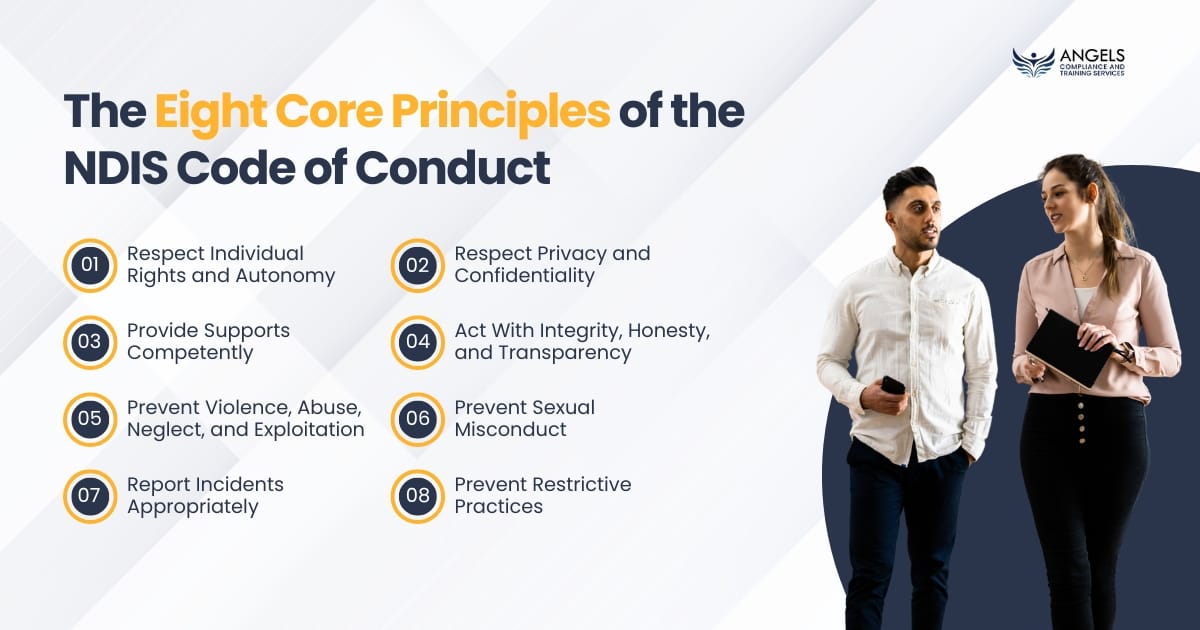
Understanding the principles of the NDIS Code of Conduct is essential. However, many providers struggle not with knowing the rules, but with applying them consistently in day-to-day practice. Each principle guides how workers should behave when supporting participants.
1. Respect Individual Rights and Autonomy
Workers must uphold participants’ dignity, privacy, and right to make their own decisions. This includes respecting choices even when staff personally disagree or would choose differently.
2. Respect Privacy and Confidentiality
All participant information must be protected, whether it is written, digital, or verbal. This includes secure record storage and avoiding casual conversations about participants.
3. Provide Support Competently
Workers must only deliver the support they are trained and authorised to provide. Working outside the scope places participants at risk and breaches compliance.
4. Act With Integrity, Honesty, and Transparency
Workers and providers must communicate truthfully with participants, families, and the Commission, including during incidents or complaints.
5. Prevent Violence, Abuse, Neglect, and Exploitation
Providers must actively identify risks and implement safeguards, rather than responding only after harm occurs.
6. Prevent Sexual Misconduct
Professional boundaries must be maintained at all times to protect participants from harm.
7. Report Incidents Appropriately
Failing to report incidents correctly or on time is itself a serious breach.
8. Prevent Restrictive Practices
Restrictive practices must be authorised, documented, and actively reduced wherever possible.
NDIS Code of Conduct Risks Nobody Talks About
Many NDIS Code of Conduct breaches do not involve obvious or intentional wrongdoing. Instead, they develop through everyday behaviours that slowly drift outside compliance and become normalised over time.
a. Poor Professional Boundaries
- Workers sharing personal details with participants
- Connecting with participants on social media
- Accepting gifts, favours, or special treatment
While these actions may seem friendly or harmless, they blur boundaries and increase the risk of dependency, power imbalance, or exploitation.
b. Inappropriate Language or Tone
- Talking about participants in public or shared spaces
- Using dismissive, patronising, or informal language
- Displaying cultural insensitivity
Respect is not just about intention; it is about how participants experience interactions.
c. Failure to Report “Minor” Incidents
- Near-misses dismissed as unimportant
- Behavioural escalations not recorded
- Delays in documenting concerns
Even low-level incidents must be documented and reviewed, as they often signal deeper risks.
d. Inadequate Supervision
- Staff working outside their approved scope
- Lack of reflective practice or feedback
- No observation or coaching
Unsupervised staff are one of the biggest compliance risks for providers.
e. Privacy Breaches in Everyday Systems
- Using WhatsApp or personal email
- Shared system logins
- Unsecured or poorly stored files
These are among the most common audit findings and highlight why NDIS Code of Conduct for providers is a systems issue, not just a staff issue.
The Real Consequences of Code of Conduct Breaches
NDIS Code of Conduct breaches carry far more than regulatory consequences. They affect participants, staff, and the long-term viability of a provider’s business.
* Regulatory Action
- Investigations: The NDIS Quality and Safeguards Commission may investigate complaints, incidents, or patterns of concern.
- Compliance notices: Providers can be issued formal notices requiring corrective action within strict timeframes.
- Banning orders: Serious or repeated breaches may result in individual workers or providers being banned from delivering NDIS supports altogether.
* Business Impact
- Loss of referrals: Support Coordinators, families, and participants may stop referring to providers with compliance concerns.
- Reputational damage: Negative findings or enforcement actions can permanently harm trust and public reputation.
- Increased staff turnover: Poor compliance culture often leads to low morale, burnout, and higher staff attrition.
* Participant Harm
- Loss of trust: Participants may feel unsafe, unheard, or disrespected, damaging the support relationship.
- Emotional distress: Breaches can cause anxiety, trauma, or disengagement from services.
- Reduced engagement with supports: Participants may withdraw from supports altogether, impacting outcomes and well-being.
Ultimately, Code of Conduct breaches undermine the purpose of the NDIS safe, respectful, and person-centred support, making proactive compliance essential for every provider.
Why Training Alone Isn’t Enough
Most providers can show training certificates. Fewer can show embedded practice.
One-off training fails when:
- There is no supervision
- Leaders don’t model behaviour
- Systems don’t reinforce expectations
Compliance is behavioural, not theoretical.
How Providers Can Reduce NDIS Code of Conduct Risk
Reducing NDIS Code of Conduct risk requires more than policies on paper. It involves embedding expectations into everyday behaviour, systems, and leadership practices.
1. Embed the Code Into Daily Practice
The Code of Conduct should be reflected in all organisational processes. Policies, induction programs, supervision frameworks, and performance reviews must clearly link back to Code principles. When staff see the Code referenced consistently, it becomes part of how work is done, not just a compliance document.
2. Ongoing Coaching and Supervision
One-off training is not enough. Regular supervision, reflective practice sessions, and coaching conversations help identify small issues before they escalate into breaches. These check-ins give staff the opportunity to ask questions, reflect on challenges, and realign with expectations.
3. Strong Incident and Feedback Systems
Staff must feel psychologically safe to report concerns, near-misses, and incidents early. Clear reporting pathways, simple documentation processes, and non-punitive responses encourage transparency and early risk management.
4. Leadership Accountability
Culture is set from the top. Leaders and managers must consistently model respectful behaviour, ethical decision-making, and accountability. When leadership lives the Code, staff are far more likely to follow it in practice.
How Angels Compliance & Training Supports Providers
At Angels Compliance & Training, we work with NDIS providers to move beyond box-ticking compliance and embed practical, real-world systems that actually work. We understand that compliance is not just about passing audits, it’s about protecting participants, supporting staff, and building a sustainable organisation.
Our support is hands-on and tailored to how providers operate day to day. We assist with Code of Conduct risk assessments to identify hidden compliance gaps across staff behaviour, documentation, supervision, and systems. These assessments help providers understand where risks exist before they escalate into incidents or regulatory action.
We deliver practical staff training and coaching that goes beyond theory, helping teams understand how the Code of Conduct applies in real situations. Our approach focuses on behaviour, decision-making, and professional boundaries, not just policies.
We also support providers in strengthening incident and reporting systems, ensuring staff know what to report, how to report it, and feel safe doing so. In addition, we help build audit-ready documentation, making compliance evidence clear, organised, and easy to maintain.
Through leadership mentoring, we support managers and directors to model conduct expectations and set a strong compliance culture from the top.
Conclusion: Compliance Is a Responsibility, Not a Checkbox
The NDIS Code of Conduct is not about avoiding penalties or passing audits; it is about protecting people. It exists to safeguard participants’ rights, dignity, and well-being, and to ensure supports are delivered ethically and safely.
When providers treat compliance as a living framework, supported by regular training, strong supervision, and accountable leadership, risks reduce, and confidence grows across the organisation. Staff feel clearer in their roles, participants feel safer, and trust is strengthened.
If you have not reviewed how the Code operates in your day-to-day practice, now is the time. The biggest risks are rarely intentional, but with the right systems in place, they are always preventable.
Frequently Asked Questions
1. Is the NDIS Code of Conduct mandatory?
Yes. The NDIS Code of Conduct applies to all NDIS workers, contractors, volunteers, and providers, whether registered or unregistered.
2. Can providers be penalised for staff behaviour?
Yes. Providers are responsible for supervision, training, and systems. If staff breach the Code, providers may face regulatory action.
3. How often should staff be trained?
Training should occur at induction, annually, and whenever incidents, risks, or policy changes arise.
4. What happens if breaches aren’t reported?
Failing to report breaches or incidents is itself a serious compliance breach and can trigger investigation or enforcement action.