

Becoming and remaining a registered NDIS provider in Australia isn’t just a badge of credibility; it’s a legal obligation. At the core of this requirement are the NDIS Practice Standards, which set the benchmark for quality, safety, and participant‑centred supports that all providers must meet. These standards are enforced by the NDIS Quality and Safeguards Commission, the independent regulator tasked with upholding quality and safety in the disability support sector.
Fail to meet these standards and your registration, the very foundation of your service delivery, could be at risk. In this article, we’ll unpack exactly what these standards are, why they matter, common pitfalls providers face, and the critical fixes you must prioritise now.
What Are the NDIS Practice Standards?
The NDIS Practice Standards are a set of quality and safety requirements that registered NDIS providers must demonstrate compliance with in order to register, renew registration, and succeed in audits.
These standards serve as measurable benchmarks across participant outcomes, organisational systems, service delivery practices, and support environments. They apply differently depending on the type of support a provider offers, but they all share the same purpose to ensure NDIS participants receive safe, high‑quality, respectful, and effective services.
Understanding the Structure: Modules and Quality Indicators
The NDIS Practice Standards are divided into distinct modules, each containing participant‑centred outcomes and quality indicators that auditors use to assess compliance.
1. Core Module
Applicable to all registered providers delivering higher‑risk or more complex supports, this includes:
- Rights & Responsibilities — ensuring participants’ legal and human rights are upheld
- Provider Governance & Operational Management — systems that ensure safe, compliant, and accountable operations
- Provision of Supports — how services are delivered to meet participants’ goals and choices
- Support Provision Environment — safety, dignity, environment, and support settings
2. Supplementary Modules
Required depending on the specific registration groups and the types of services you provide. These include:
- High Intensity Daily Personal Activities
- Specialist Behaviour Support
- Implementing Behaviour Support Plans
- Early Childhood Supports
- Specialist Support Coordination
- Specialist Disability Accommodation
3. Verification Module
Applies to lower‑risk supports and focuses on fundamental systems such as human resources, risk management, complaints handling, and incident management.
Each module has quality indicators with specific measurable expectations that auditors will review to determine whether standards are met.
Why NDIS Practice Standards Matter
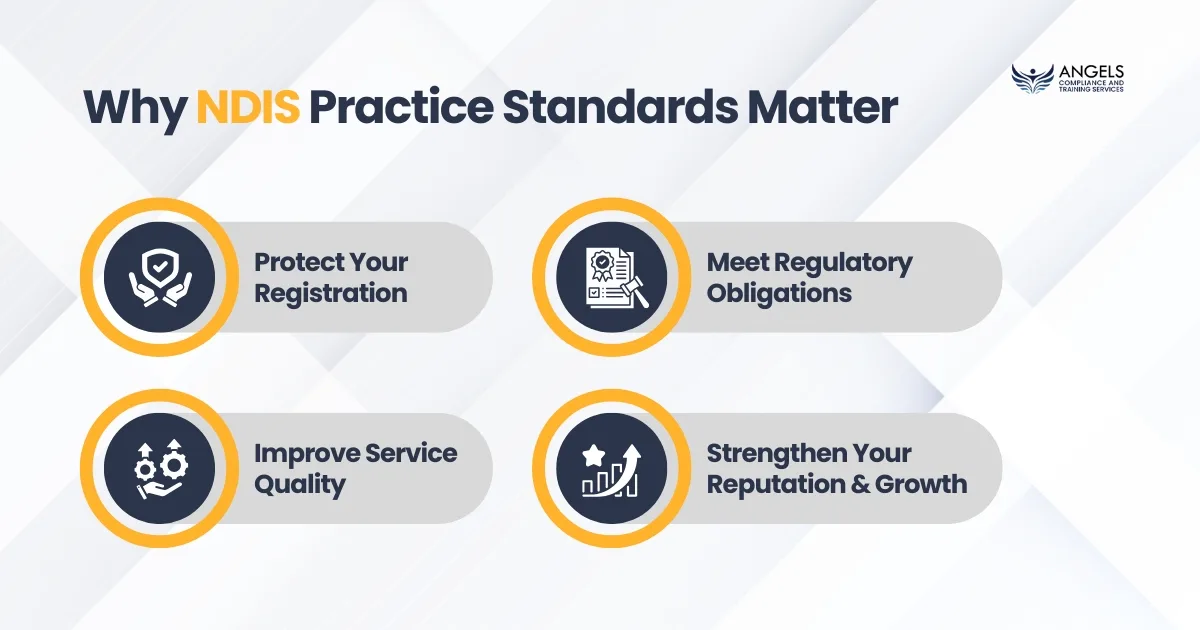
a. Protect Your Registration
Failing to demonstrate compliance during an audit can result in major non‑conformities, delaying or jeopardising your registration or renewal. You might be given time to fix issues, but this can disrupt operations and damage your reputation.
b. Meet Regulatory Obligations
Compliance is not optional. Registered providers must adhere to the NDIS Practice Standards and Quality Indicators as mandated by the NDIS Commission.
c. Improve Service Quality
These standards help you build systems that prioritise participant dignity, choice, control, and safety. Embracing them can improve participant outcomes and satisfaction.
d. Strengthen Your Reputation and Growth
Demonstrated compliance signals professionalism and commitment to quality, building trust with participants, families, referrers, and funding bodies.
Common Compliance Gaps Providers Must Fix Now
Even experienced providers can struggle with areas that often trigger audit findings. Here are the most common gaps that put your registration at risk:
1. Incomplete or Outdated Policies and Procedures
Your documentation must clearly align with the Practice Standards for outcomes, not generic templates. Quality and timely evidence matter.
2. Weak Governance or Risk Management Systems
A lack of structured governance, risk registers, quality improvement, and accountability frameworks often results in non‑conformities.
3. Poor Record‑Keeping
Incomplete records of training, incidents, complaints, or participant feedback can undermine your compliance claims.
4. Limited Evidence of Participant Engagement
Auditors look for real evidence that support was planned collaboratively with participants and delivered as agreed.
Core Component Fixes You Can Implement Today
To strengthen your compliance position now, focus on these critical areas:
✔ Rights & Responsibilities
- Ensure policies reflect respect for choice, control, privacy, and cultural values.
- Maintain evidence of participant involvement in support planning.
✔ Governance & Operational Management
- Embed risk, quality, and information management systems.
- Delegate clear responsibilities and document oversight processes.
✔ Provision of Supports
- Have robust service agreements, progress notes, and activity logs.
- Ensure supports match the agreed service plan and reflect participant goals.
✔ Support Environment
- Demonstrate safe procedures for medication, property management, mealtimes, and participant safety.
Supplementary Module Essentials
If your service delivery includes higher‑risk or specialised supports, focus on the specific modules that apply to your registration groups:
- Specialist Behaviour Support — evidence of best practice behaviour support plans
- High Intensity Daily Personal Activities — staff competencies, monitoring, and safety demonstrations
- Early Childhood Supports — tailored, evidence‑based approaches to early intervention.
Steps to Audit‑Ready Compliance
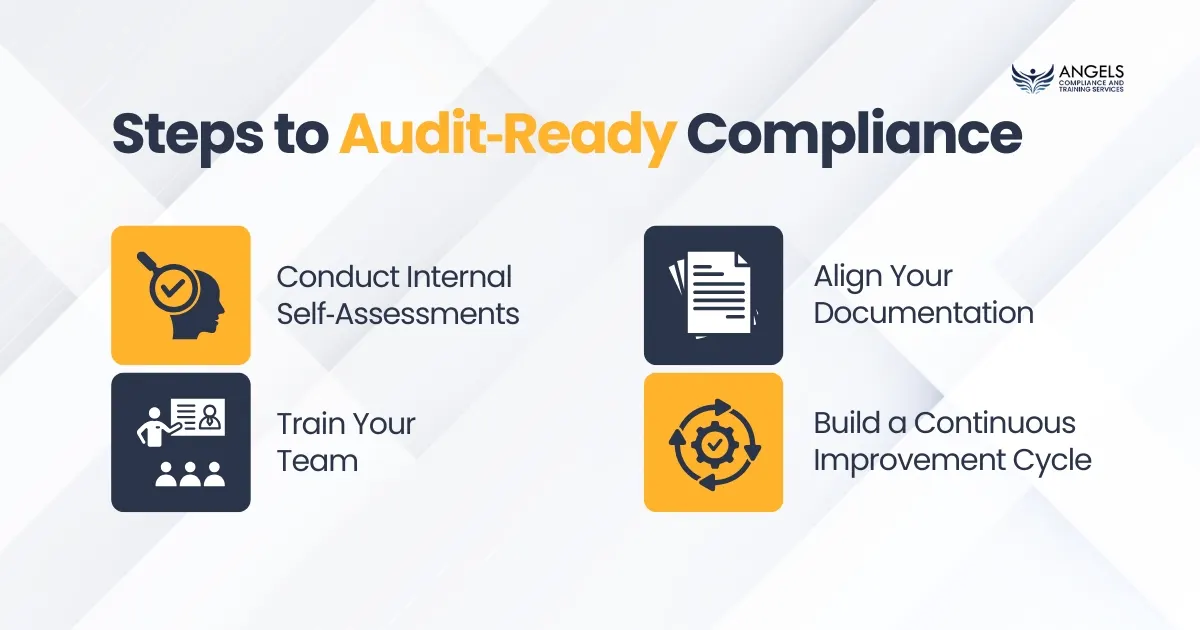
Preparing for an audit doesn’t have to be overwhelming. Here’s a simple roadmap:
1. Conduct Internal Self‑Assessments
Map your systems against each relevant Practice Standard and quality indicator. Be honest, find gaps before auditors do.
2. Align Your Documentation
Ensure policies, procedures, registers, training records, and evidence files clearly support compliance.
3. Train Your Team
Staff must understand their role in compliance, from documentation to participant engagement.
4. Build a Continuous Improvement Cycle
Use complaints, feedback, incident analysis, and audit results to continuously uplift your systems.
Remember: auditors seek evidence that the services you say you deliver are actually being provided in practice, with supporting documentation to back it up.
Conclusion
The NDIS Practice Standards and Quality Indicators aren’t just regulatory hurdles, they are tools that build safer, stronger, participant‑centred services. However, failing to address shortcomings in your systems, procedures, documentation, or staff awareness can risk your NDIS registration and limit your growth.
But you don’t have to navigate this complexity alone.
Ready to Secure Your Registration and Self‑Assess with Confidence?
Angels Compliance and Training is your partner in achieving and maintaining NDIS compliance. Whether you’re preparing for initial registration, renewal, verification or certification audits, or undertaking your self‑assessment against NDIS Practice Standards, our team of experienced consultants will guide you step‑by‑step toward a successful outcome.
Contact Angels Compliance and Training today for expert support with:
- NDIS Practice Standards compliance
- Self‑assessment and gap analysis
- Policy and procedure development
- Audit readiness and documentation support
Don’t risk your registration – act now to strengthen your compliance and quality systems.
FAQs
Q: What are the NDIS Practice Standards?
The NDIS Practice Standards are quality benchmarks that registered NDIS providers must meet to deliver safe and high‑quality supports.
Q: How do quality indicators relate to the Practice Standards?
Quality indicators are the measurable criteria auditors use to assess compliance with each Practice Standard.
Q: When is a verification audit required?
A verification audit applies to providers offering lower‑risk services, assessing core compliance areas at a desktop level.
Q: What happens if my audit finds non‑conformities?
Major non‑conformities must be addressed promptly before registration can proceed; minor non‑conformities have a defined timeframe for correction.
Q: Can self‑assessment help with audit preparation?
Absolutely. Self‑assessment allows you to identify and fix gaps before auditors review your evidence.