

Ask any NDIS provider what keeps them awake at night, and cash flow is usually near the top of the list. You have delivered the supports, your staff have been paid, and yet the money owed to you is sitting somewhere between a service booking and a bank account held up by a rejected claim, a missing field, or a plan manager waiting on a corrected invoice.
The frustrating part is that most payment delays are entirely avoidable. They rarely come down to the quality of your service. They come down to the paperwork: an invoice missing a support item number, a claim submitted against the wrong management type, a date that doesn’t line up with the service booking. Get the mechanics of NDIS invoicing right, and the same claim that used to bounce back now clears in a couple of business days.
This guide walks through what a compliant invoice actually needs, how payment timing differs depending on how a participant’s plan is managed, the mistakes that quietly cost providers weeks of cash flow, and the record-keeping habits that keep you audit-ready. Everything here reflects the current NDIA rules as they stand in 2026, worth noting, because the payment framework has shifted more than once in the past two years.
Why invoicing is a compliance issue, not just an admin task
It is tempting to treat invoicing as the boring bit at the end of service delivery. In practice, your invoice is a compliance document. It is the point where clinical service, funding rules and financial record-keeping all meet, and it is one of the first things an auditor or a payment reviewer will look at when they want to test whether your claims genuinely reflect the supports you delivered.
The NDIA actively monitors payment requests to make sure claims accurately reflect the services that were actually delivered. That means a sloppy invoice is not just a delayed payment; it is a data point about how well your organisation controls its records. Providers who invoice cleanly and consistently tend to sail through payment reviews. Providers whose claims are inconsistent, vague or frequently corrected attract exactly the kind of scrutiny nobody wants.
There is also a direct link between invoicing discipline and the outcome of your registration audit. The NDIS Practice Standards require registered providers to keep accurate and complete records of the supports they deliver, and assessment of your financial and record-keeping systems forms part of what auditors examine. An invoice trail that is clean, dated and traceable is quiet evidence that your governance works. So getting NDIS invoicing right pays off twice: faster payments now, and fewer headaches when your audit comes around.
What a compliant NDIS invoice must contain
Before anything else, get the contents of the invoice itself right. According to the NDIA’s guidance on invoicing and record keeping, a compliant invoice should include the following details. Treat this as your master checklist and build it into your template so nothing is left to memory.
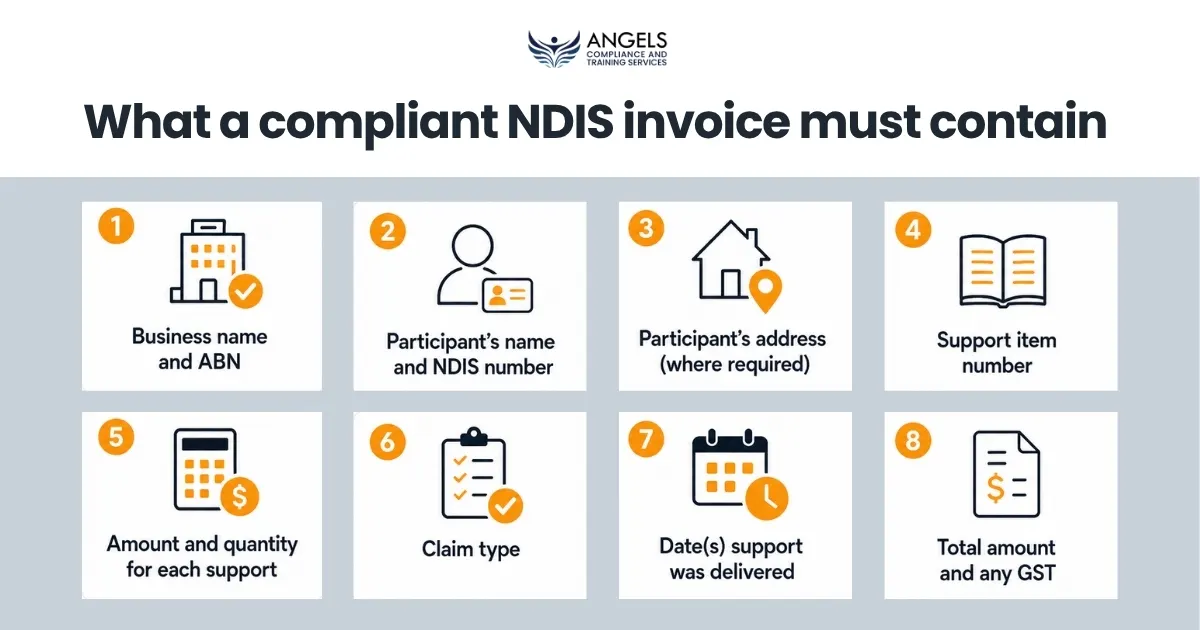
1. Your NDIS business name and ABN
The invoice must carry your registered business name and a valid Australian Business Number. If you are exempt from quoting an ABN, you need to attach a “statement by a supplier” form, which is available from the Australian Taxation Office. This single field is one of the most common reasons plan-managed invoices get bounced back.
2. The participant’s name and NDIS number
Every invoice must identify the participant it relates to. A crucial rule that trips up new providers: an invoice can only be for one participant, though it can include multiple supports for that person. Do not batch several participants onto one document.
3. The participant’s address, where required
Include the participant’s address and postcode where the support relates to specialist disability accommodation. For most other supports this is not needed, but knowing when it applies avoids a preventable rejection.
4. The support item number from the Support Catalogue
Each line must reference the correct support item number as listed in the current NDIS Support Catalogue. Using an outdated or mismatched item code is one of the fastest ways to get a claim rejected, especially since the pricing framework was overhauled. Our explainer on the new NDIS pricing schedule that replaced the price guide covers what changed and where to find current codes.
5. Amount and quantity for each support
State the price per unit and the number of units clearly; for example, “$51.09 each x 2 units.” The delegate or plan manager should never have to do arithmetic to work out what you are claiming.
6. The claim type
Specify the type of claim where relevant: standard face-to-face support, non-face-to-face support, provider travel, short notice cancellation, or an NDIS requested report. Getting this wrong can push a legitimate claim into a category the plan does not fund.
7. The date or dates the support was delivered
Every line item needs the actual service date. Dates must line up with your service agreement and, for NDIA-managed participants, with the service booking in the portal.
8. The total invoice amount and any GST
State the total payable and the GST component if it applies. Most NDIS supports are GST-free, but where GST does apply it must be shown separately and correctly.
Build these eight fields into a standard template, and the single biggest source of payment delays the incomplete invoice largely disappears.
How you get paid depends on how the plan is managed
Here is the part that confuses more providers than any other: the invoicing process is not the same for every participant. It changes depending on how the participant’s funding is managed, and sending the right document to the wrong destination is a guaranteed delay. There are three arrangements, and you need to handle each differently.
a. Agency-managed (NDIA-managed)
If a participant’s plan is managed by the NDIA, you submit a payment request directly through the myplace provider portal rather than sending a separate invoice to the Agency. You must have a service booking in place before you deliver the support, and you need to be recorded as a “my provider” to be paid promptly. You still keep your own detailed invoice records in case of an ATO or NDIS audit; you just don’t post them to the NDIA.
b. Plan-managed
If a plan manager is helping the participant, you send your invoice directly to that plan manager, not to the NDIA and not through the portal. The invoice must include your valid ABN (or the supplier statement if exempt), and the plan manager then enters the claim into the portal on your behalf. This is where clean, complete invoices matter most, because a plan manager will simply return anything that doesn’t add up.
c. Self-managed
If a participant self-manages their funding, you invoice the participant directly, and they pay you. After they have paid, you provide a receipt so they can acquit the expense against their plan through the participant portal. Relationships and clear communication carry a lot of weight here, because you are dealing with the participant themselves rather than an intermediary.
The reason this matters for cash flow is simple: each route has a different chain of hands, and each hand is a potential point of delay. Knowing which route applies to each participant before you invoice and setting your systems up accordingly is one of the highest-leverage things you can do to get paid faster.
Payment timeframes and deadlines you can’t afford to miss
Timing is where good intentions meet hard rules. There are two clocks running, and both matter.
The first is how fast you get paid once a claim is lodged. Valid claims from providers recorded as a “my provider” are usually paid within two to three business days. If you are not recorded as a my provider, or if the NDIA needs to check that your claim is accurate, payment can take around ten business days. In practical terms, a valid claim submitted before midnight on a Monday is generally in your account by Wednesday. Being set up correctly as a myGov provider is, on its own, one of the simplest ways to shorten your payment cycle.
The second clock is the deadline to claim at all. For NDIA-managed participants, you must submit your payment request within 90 days from the end of a service booking. More broadly, payment requests need to be submitted within two years after a support has been delivered. There is a catch in between: if you submit a claim more than six months after delivering a service, the NDIA may hold it for a review that can take up to 28 days. The lesson is to claim promptly, ideally weekly rather than letting invoices pile up. Old claims are slow claims.
It also helps to understand what happens when a claim is queried. If the NDIA needs more information to verify a claim, it puts the claim on hold and contacts you in writing, and you have at least 14 business days to respond. If the claim is then approved, it is paid within the usual two to three business days. If it is not compliant or valid, it is rejected outright, and you are told why. Responding quickly and completely to these requests is far better than resubmitting from scratch.
Common NDIS invoicing mistakes that delay payment
Across the providers we work with, the same handful of errors account for most rejected or delayed claims. None of them are complicated, which is exactly why they are so frustrating when they cost you a fortnight of cash flow.
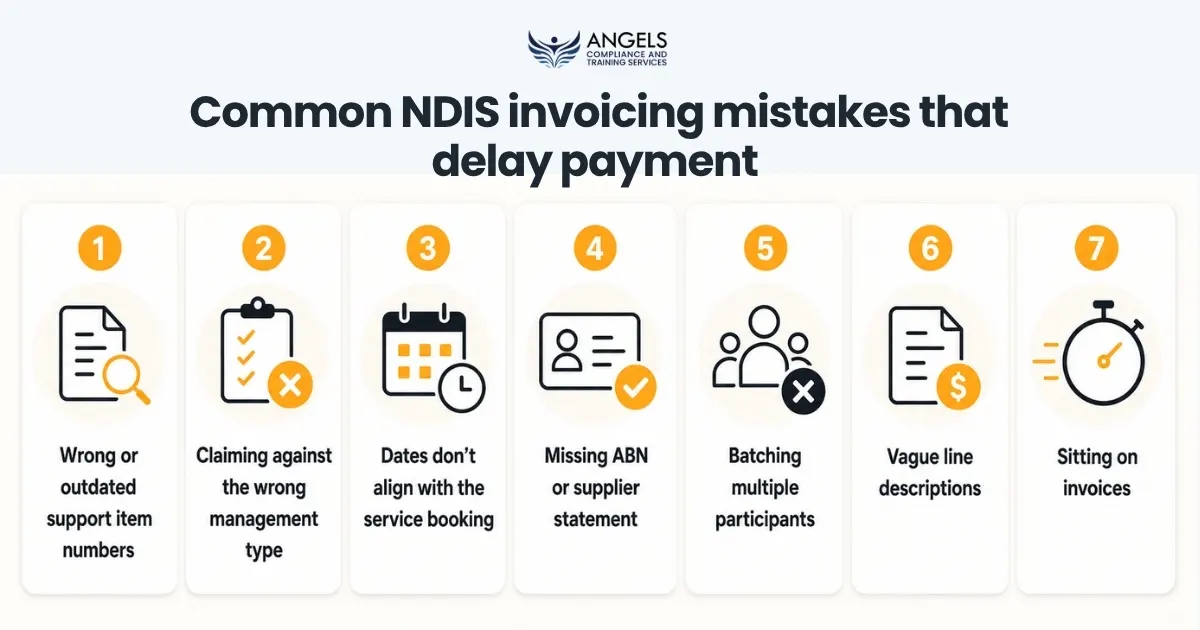
* Mismatched or outdated support item numbers
Using a code that no longer exists, or that doesn’t match the support actually delivered, is the classic rejection. Always claim against the current Support Catalogue.
* Claiming against the wrong management type
Sending a portal payment request for a plan-managed participant, or emailing an invoice for an agency-managed one, sends your claim down a dead end. Confirm the management type before you invoice.
* Dates that don’t align with the service booking
For NDIA-managed claims, a service date outside the service booking window will fail. Check that your bookings cover the period you are claiming for.
* Missing ABN or supplier statement
For plan-managed and self-managed invoices, a missing ABN is an instant hold. If you are ABN-exempt, attach the supplier statement every time.
* Batching multiple participants on one invoice
Because an invoice can only relate to one participant, combining several is a structural error that forces a full redo.
* Vague line descriptions like
“Support services $600” invites questions. Itemised units, rates, and dates get approved.
* Sitting on invoices
Every week you wait is a week closer to the six-month review threshold and the two-year cut-off. Prompt claiming is free money-flow optimisation.
If claims are bouncing back repeatedly and you are not sure why, that pattern is usually a symptom of a wider records or systems gap the same kind of gap that shows up at audit. Our guide to the top reasons NDIS providers fail audits covers how these small process failures compound.
Record-keeping: the other half of getting paid
Submitting the claim is only half the job. The NDIA expects you to keep detailed records that back up every payment request, and those records are exactly what a payment review or an audit will test. Even when you claim through the portal and never send the NDIA a formal invoice, you must retain your own invoice and supporting documentation.
Good record-keeping means keeping, for each claim, the invoice or payment request, the service agreement, evidence that the support was delivered (progress notes, shift records or session notes), and proof the participant’s plan funded that support. Store these securely, keep them for the required retention period, and make sure an amended invoice is version-controlled so the trail is traceable. When a reviewer asks you to substantiate a claim from four months ago, a tidy, retrievable record is the difference between a quick resolution and a stressful scramble.
This is also where invoicing connects to your broader compliance posture. The systems that produce clean invoice templates, review steps, and secure storage are the same systems auditors sample. If yours feel shaky, our NDIS policies and procedures resources are a practical starting point for tightening them, and providers heading into a first or renewal audit can get structured help through our NDIS audit compliance support.
A simple pre-send checklist
Before any invoice or payment request leaves your organisation, run it past six quick questions. Is the correct management type identified, and is the claim going to the right destination? Are the business name, ABN, and participant details all present and correct? Does every line carry a current support item number, unit price, quantity, and service date? Do the dates fall within the service booking or agreement? Is GST handled correctly, and does the total add up? And is there a complete record behind this claim if someone asks you to prove it?
If you can answer yes to all six, your claim is very likely to clear on the first pass, which is the whole point. Faster payment is rarely about chasing the NDIA harder. It is about giving them nothing to query.
Getting your invoicing process audit-ready
Individual invoices improve when you fix a template. Whole organisations improve when invoicing becomes a defined process: a standard template, a second-set-of-eyes check before submission, prompt weekly claiming, and a records system that ties every payment back to a delivered support. That discipline protects your cash flow and quietly strengthens your position at audit at the same time.
Angels Compliance and Training Services works with NDIS and DVA providers across Australia on exactly this kind of operational discipline, alongside registration, renewal and audit preparation. If your payments are slower than they should be, or your invoicing and record-keeping wouldn’t comfortably survive a review, that gap is fixable and usually fixable fast. Get in touch with our team to talk through where your process is losing time and money, or explore our NDIS compliance coaching if you’d like ongoing support building it into everyday practice.
This article is general information for NDIS providers and is current at the time of publication. It is not financial, tax, or legal advice. NDIS payment rules and pricing arrangements continue to change; always check current guidance at ndis.gov.au before relying on any process described here.